


April 29, 2026



PRESENTED BY

THE TOP
It’s all falling apart for House GOP this week
Happy Wednesday morning.
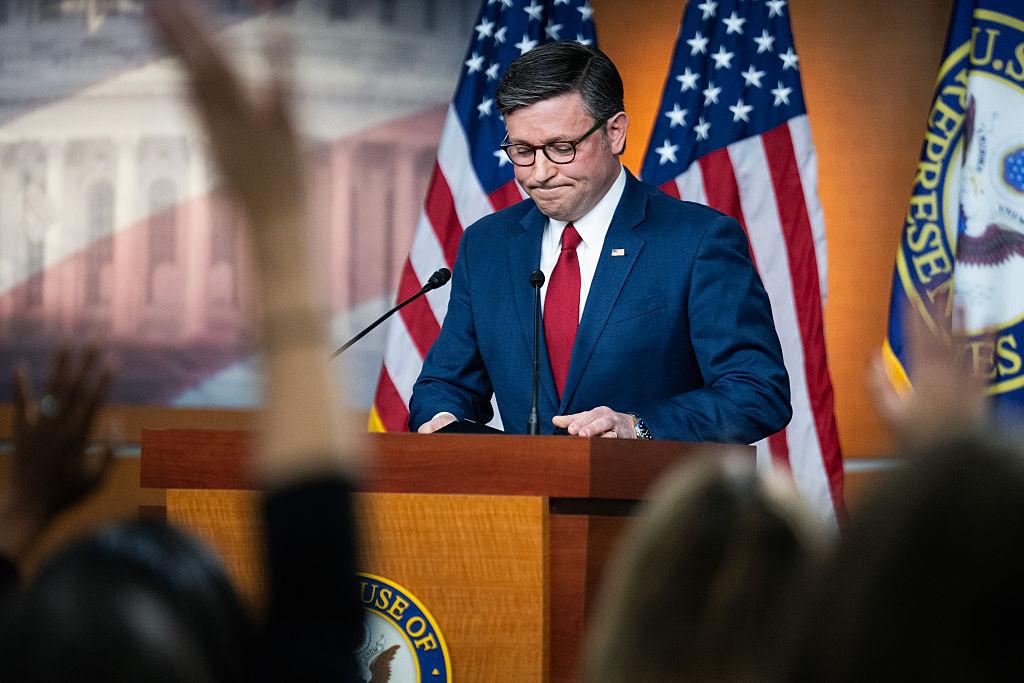
The wheels are coming off the House Republican Conference.
In a week that was supposed to set the tone for a furious period of election-year legislating, Speaker Mike Johnson’s House GOP majority is once again the epitome of discord and dysfunction.
It’s not really clear how House Republicans will get through the next few days. Johnson’s leadership team may lose yet another big rule vote. There’s constant grumbling inside House Republican leadership circles as people snipe at one another. Senate Republicans are furious with their House GOP counterparts. The White House seems fed up with the chaotic House GOP conference too. Plus, the stakes couldn’t be higher, politically and policy-wise.
After a Rules Committee hearing that stretched from Monday to Tuesday, House GOP leadership plans to go to the floor today with a blueprint for debating several key bills. These include a FISA Section 702 renewal; a farm bill; legislation allowing the year-round sale of E15 ethanol fuel; and a budget resolution to fund ICE and Border Patrol.
But that GOP-drafted rule looks destined to fail, another potentially devastating misstep for Johnson and his top lieutenants.
And then what? Will Johnson keep the House in over the weekend? Will Johnson cancel the upcoming week-long May recess? Will Johnson have to punt to the Senate to ensure that the nation’s most critical foreign surveillance program doesn’t expire?
House Republicans want to portray themselves as the “grownups” in Washington ahead of what’s expected to be a difficult midterm election. But at this point, they look like amateurs — and their majority is in deep trouble.
The legislative morass. Despite months of internal discussions, House Republicans can’t agree among themselves about how to move forward on extending FISA Section 702, a critical surveillance authority that expires Thursday. Johnson has given his conservatives everything they’ve wanted on FISA except one provision — mandating judicial warrants for any Section 702 inquiry involving a U.S. person. Johnson won’t cave, and neither will conservatives, leading to massive confusion over what’s happening with the program.
Even more importantly, the White House sent Capitol Hill a memo Tuesday night basically ordering House Republicans to move forward with a Department of Homeland Security funding bill already passed by the Senate.
OMB officials said that without that bill, they won’t be able to pay 270,000 DHS employees next month. DHS has been shut down for 74 days now in a dispute with Democrats over ICE reforms, and its employees are getting paid under two executive orders from President Donald Trump. Remember — this is FY2026 funding we’re talking about, and it’s nearly seven months into the fiscal year.
The minority rules. Once again, Democrats are making the most out of the GOP’s mess. House Rules Committee Democrats inflicted hours of pain during Tuesday’s session, offering dozens of amendments during the markup from rank-and-file Republicans one by one. This forced the GOP majority to vote against their colleagues’ proposals.
Democrats were looking to secure defections on the rule that will theoretically be on the floor this morning. They succeeded with at least two: Reps. Lauren Boebert (R-Colo.) and Nancy Mace (R-S.C.) said they’d oppose the rule after their amendments got rejected. Democrats made direct pleas to try to peel off others.
“This is chaos, it’s incompetence, amateur hour,” Rep. Jim McGovern (D-Mass.), ranking member of the Rules Committee, said of the “shitty” GOP leadership. “This is not a normal process. This is dysfunctional,” McGovern added.
Exiting the hearing Tuesday night, Republicans were openly skeptical about whether the rule they just approved could clear the floor.
“I think you still have FISA problems. I don’t think it has the warrant protections it needs. CBDC is going to be stripped out in the Senate,” Rep. Chip Roy (R-Texas) said of the ban on a central bank digital currency.
Rep. Ralph Norman (R-S.C.) added that it’s up to Johnson “to get the vote count.”
“We’ll see if he’s got it,” Norman quipped.
Tensions rising. Johnson’s inability to pass just about anything is intensifying frustration among Senate Republicans.
Senate Majority Leader John Thune was uncharacteristically blunt Tuesday night about House GOP leaders’ attempt to send the Senate a FISA extension that includes a ban on a central bank digital currency, calling it “dead on arrival.”
“They know that,” Thune added. Those comments immediately angered House GOP hardliners.
Thune then told reporters that he’s been open to discussing a House-requested “technical fix” to the Senate’s bipartisan bill funding DHS. “But I think the thing to do is just to pass the [Senate-approved] bill,” Thune said.
The South Dakota Republican is rarely willing to tell the House what to do. But Johnson’s decision to hold off on passing the bipartisan DHS bill for 28 days — under immense pressure from his members — is clearly striking a nerve with Thune.
Senate GOP leaders are still trying to give the House space to work out a path on FISA but don’t feel they can wait much longer. The Section 702 authority expires Thursday. That means the Senate will need unanimous consent to speed up passage and meet the deadline no matter what.
Depending on what happens in the House, the Senate could hold a procedural vote on a FISA extension this afternoon. Senate Intelligence Committee Chair Tom Cotton (R-Ark.) is working on a bill that would extend FISA for three years with some reforms.
Also … News: Reps. Josh Gottheimer (D-N.J.) and Mike Lawler (R-N.Y.) have a new resolution condemning Hasan Piker and Candace Owens for “antisemitic hate-filled rhetoric.” If this ever makes it to the House floor, it would be quite the vote.
— Jake Sherman, John Bresnahan, Anthony Adragna, Briana Reilly and Laura Weiss


THE SENATE
How Tillis won Fed fight with Trump
In an era of overwhelming GOP deference to President Donald Trump, Sen. Thom Tillis (R-N.C.) reminded his colleagues that they have more power than they think — or care to use — to rein in the White House.
More often than not, fear of an angry Trump comment or Truth Social post is the main consideration among GOP lawmakers. Tillis has gotten his fair share of those. He’s also not running for reelection, an announcement Tillis made following a showdown with Trump and Senate Republican leaders on Medicaid cuts last year.
But Tillis’ victory over Trump’s efforts to criminally target Fed Chair Jay Powell and undermine the central bank’s independence provided a blueprint for GOP senators looking to use their unique power to check White House behavior.
“Some of our members just randomly put holds on [nominees] and they have no way out. They shouldn’t go into a box canyon,” Tillis said in an interview. “You want to be judicious. And you need to be in a position to follow through. I’m really using it, in many cases, for things that I think most of my colleagues are OK with.”
Tillis, who’s the deciding vote in the Senate Banking Committee, used that leverage to block all Fed nominees until the Justice Department ended its criminal investigation into Powell. Tillis made clear that this was the only way for Trump to win Senate confirmation for Kevin Warsh, his pick to replace Powell.
It worked. Unlike the blanket holds senators often deploy, Tillis’ blockade was narrow and focused, making it more likely to succeed.
The politics. Senate Republicans are publicly thanking Tillis for exercising his leverage in ways they themselves believed they couldn’t. It’s a recognition of the political risk Republicans face when standing up to Trump, especially on a big issue like this.
“He’s not running for reelection, and [Tillis] saw the opportunity to address it where nobody else had to,” said Sen. Mike Rounds (R-S.D.), who’s on the ballot this year. “I appreciated the fact that he stepped in at that point and was insistent that we resolve this issue, because a number of us felt the issue needed to be resolved.”
Tillis often reminds reporters that he deployed these leverage plays even before announcing his retirement. For example, Tillis tanked Ed Martin’s U.S. attorney nomination over Martin’s posture toward the Jan. 6 Capitol riot.
Tillis acknowledged that his Fed move would’ve been risky for most other Senate Republicans, but he said the worsening political environment for the GOP may force some Republicans to show separation from Trump.
“Every single member has a unique relationship [with Trump]. And I like to think that some of mine is built on mutual respect,” Tillis said. “We’ve got to be willing to say, ‘I’m not doing this to hamper the president’s legacy. I’m actually doing it to improve it.’”
Inside the Warsh blockade. In this case, Tillis was speaking for more than just himself. That included Senate Majority Leader John Thune.
“We want to get things done around here, and sometimes you have to work around individual members… We do that every day,” Thune told us. “But this was an example of one where [Tillis] held his ground and ultimately this was, in my view, the right outcome.”
These kinds of blockades are usually among the more frustrating things a party leader has to deal with, but Thune used this one to his advantage. Thune’s public comments throughout the saga showed he was trying to leverage Tillis’ roadblock to push the administration to drop the Powell probe. It was successful, and Thune was shielded from the political fallout.
— Andrew Desiderio
PRESENTED BY AMAZON

Amazon has invested more than $2.5 billion in safety efforts, including new innovations, ergonomic improvements, and training programs since 2019. Discover more.
A LOOK UNDER THE HOOD
Bad new polls for House Republicans
We have a new crop of House Republican-commissioned polls that offer fresh insight into the political environment and a midterm warning sign for the GOP.
Conservatives For America, a political organization linked to Republican Study Committee Chair August Pfluger (R-Texas), posted nine polls for GOP-held districts on its website, possibly to give to a super PAC without running afoul of campaign-finance limits on coordination.
These polls, conducted in mid-March by Ragnar Research Partners, are of districts that range from deep-red ones held by Reps. Tim Moore (R-N.C.) and Pat Harrigan (R-N.C.) to battlegrounds held by Reps. Zach Nunn (R-Iowa) and Juan Ciscomani (R-Ariz.). The sample sizes were 400 likely voters each.
Here’s what stood out to us from this trove of data.
Trump’s numbers. President Donald Trump is underwater in districts that he won in 2024. Obviously, Trump isn’t on the ballot this November. But if his poll numbers sink low enough, Trump could pull vulnerable Republicans down.
For example, Trump won Rep. Bryan Steil’s (R-Wis.) district by five points in 2024. But in this polling, Trump’s image is upside down by seven points. Trump’s job approval rating is upside down by five points.
Rep. Jeff Hurd’s (R-Colo.) district swung for Trump by 10 points last election. But now the president’s image is -4 and his job approval is -2.
Other districts where Trump is underwater include those held by Ciscomani, Nunn and Rep. Bill Huizenga (R-Mich.). Those districts are top DCCC targets.
Some of these vulnerable House Republicans have better numbers than Trump. Huizenga’s image and job approval are right-side up. Yet the danger here is these GOP incumbents will only be able to run so far ahead of a slumping Trump.
Generic ballots. Democrats are winning the generic ballot in some of these polls. Democrats are leading by two points in Steil’s district and up one point in Ciscomani’s district.
Republicans are winning by just one point in Nunn’s district and Huizenga’s district.
Another notable generic ballot: Republicans are only up five points in Rep. Brad Finstad’s (R-Minn.) district, one that Trump won by 12. Finstad, however, was up 10 points.
Arizona. The most concerning data set for Republicans is in Ciscomani’s district. The incumbent trails Democrat JoAnna Mendoza by three points, 47% to 44%. Ciscomani’s image is underwater by four points and his job approval is -6.
This seat is one of Democrats’ top pickup opportunities, and these numbers only underscore the GOP challenge.
There is also a warning sign in Colorado’s 3rd District. Hurd leads his Democratic opponent by five points. But his image and job approval are upside down by nine points and 11 points, respectively.
The good news for the GOP. Most of the Republican incumbents beat their Democratic opponents in head-to-head polls.
Steil was up nine points. Huizenga led Democrat Sean McCann by six points. Nunn was also up six over Democrat Sarah Trone Garriott.
But we will note that most, if not all, of these Democrats haven’t begun advertising to raise their name ID. It’s typical for the incumbent to lead at this point in the cycle. Democrats have room to grow.
– Ally Mutnick and Jake Sherman

DEFENSE
Hegseth’s brutal Hill showdown awaits
Defense Secretary Pete Hegseth will face a gauntlet of tough questions on the Iran war on Wednesday when Congress confronts him publicly for the first time since the start of the conflict.
Hegseth will testify starting at 10 a.m. before the House Armed Services Committee. The appearance comes as the Iran conflict nears the 60-day mark and Republicans are growing increasingly anxious for a clear exit strategy.
Hegseth’s written remarks — which we obtained — barely mention Iran, instead centering on the Trump administration’s $1.5 trillion FY2027 request for the Pentagon. But his statement issues a warning to U.S. allies, who Hegseth said haven’t done enough to aid American military operations in the region.
“This is unconscionable — and we will remember,” Hegseth wrote.
Meanwhile, Armed Services Committee Chair Mike Rogers (R-Ala.) will tout the Trump administration’s planned defense investments and underscore the threat China’s massive military buildup poses.
“It is critical we do not reduce deterrence as our allies ramp up their own capability,” Rogers will say, according to his opening statement.
Democrats forecast a series of topics they plan to press Hegseth on beyond Iran: DOD’s spending request, the military’s posture abroad and recent turmoil in the Pentagon’s top ranks.
What if there’s something that doesn’t come up today? Hegseth will return to Capitol Hill Thursday at 11 a.m. alongside Joint Chiefs of Staff Chair Gen. Dan Caine (read Caine’s written testimony here).
— Briana Reilly and Anthony Adragna
📆
What we’re watching
House. Members could be in for a late night of voting if House GOP leaders get their way. After a fitful markup, the House Rules Committee approved a multi-faceted rule that covers FISA Section 702 renewal, the farm bill, ICE and Border Patrol funding, plus a Republican gender identity measure.
The House comes into session at 9 a.m., with the first votes set for 10:30 a.m. If House GOP leaders can jam through the rule (a big if), then the FISA Section 702 vote will be held later tonight. The controversial surveillance authority expires on Thursday.
Defense Secretary Pete Hegseth and Joint Chiefs of Staff Chair Gen. Dan Caine will sell their $1.5 trillion FY2027 budget request to members of the House Armed Services Committee at 10 a.m.
The Energy and Commerce Committee will hold a hearing on building AI data centers while protecting ratepayers at 10:15 a.m.
Punchbowl News Tech Reporter Ben Brody interviews GOP Reps. John Joyce (Pa.) and Bill Huizenga (Mich.) about the Energy and Commerce and Financial Services committees’ privacy bills at 2:30 p.m.
Senate. The Senate convenes at noon. There will be afternoon and evening votes on a nomination and CRAs from Democrats. Depending on what happens in the House, senators could begin voting as soon as this afternoon on a FISA bill. But there are no FISA votes scheduled yet.
The Senate Banking Committee votes on the nomination of Kevin Warsh to be the next Federal Reserve chair at 10 a.m.
Several Trump administration officials will be in the Senate for budget hearings, including Interior Secretary Doug Burgum before the Energy and Natural Resources Committee at 9:30 a.m. and EPA Administrator Lee Zeldin before the Environment and Public Works Committee at 2:30 p.m.
Sen. Bernie Sanders (I-Vt.) will host international scientists to discuss the “Existential Risks of AI” at 7 p.m.
Washington. President Donald Trump will host Artemis II astronauts at the White House at 2 p.m.
Federal Reserve Chair Jay Powell hosts his final FOMC press conference at 2:30 p.m.
Florida. Lawmakers in Tallahassee are expected to vote on the Sunshine State’s proposed new congressional map during the special session. This could add as many as four new Republican House seats.
— Laura Weiss, Brendan Pedersen and John Bresnahan
PUNCHBOWL NEWS EVENTS
Townhouse Coffee with First Responders

On Tuesday morning we hosted “Townhouse Coffee with First Responders,” an event that featured networking and a fireside chat about the importance of FirstNet in helping to keep first responders, and the communities they serve, safe.
Punchbowl News Founder Jake Sherman sat down for a conversation with David Hoagland, president of the District of Columbia Firefighters Association IAFF Local 36, AFL-CIO, and captain of DC Fire & EMS, and Jeffrey Ackerman, chief of police of the Duck, N.C., Police Department. Thank you to AT&T for partnering with us on this event.
Joining us: Dan Miller of the House Energy and Commerce Committee; Madeleine Fleenor of the Senate Commerce Committee; Carrie Johnson of the FirstNet Program; and Steven Alonzo of the International Association of Fire Chiefs.
Also there: Chelsea Davis and Evan Davis of the International Association of Fire Fighters; Seamus Dowdall of the National Association of Counties; Estuardo Rodriguez of Intersect Public Affairs; Michelle Santuoso of Main Street Media Group; and Jack Finnegan of Kongsberg Defense & Aerospace.

Presented by AstraZeneca

The 340B program is supposed to help vulnerable patients—but without strong safeguards, it’s siphoning away funds that could be used for free and charitable medicine. The 340B Rebate Model Pilot improves program integrity, preventing duplicate discounts and strengthening accountability. Urge HHS to implement the pilot today. Learn why it matters.

Crucial Capitol Hill news AM, Midday, and PM—5 times a week
Join a community of some of the most powerful people in Washington and beyond. Exclusive newsmaker events, parties, in-person and virtual briefings and more.
Subscribe to Premium
Special Projects
Explore our deep dives into the issues that matter the most today and will shape tomorrow's future, with expert reporting that goes beyond the headlines and into the heart of the Capitol.
Check it outEvery single issue of Punchbowl News published, all in one place
Visit the archive
Presented by AstraZeneca
The 340B program lacks transparency—making it hard to tell if it’s actually helping vulnerable patients. HHS can fix the problem by implementing the 340B Rebate Model Pilot, ensuring the program is transparent, compliant, and accountable. Learn more.