

PRESENTED BY

THE TOP
The political landscape for tech

Welcome to our Punchbowl News Tech Quarterly Edition!
Every three months, we send a Tech newsletter to all of our Punchbowl News subscribers offering a glimpse of the type of reporting we provide our Premium Policy audience on a daily basis.
In this edition, we’ll walk you through how America’s chipmakers are navigating an immensely important time in Washington for the industry. With artificial intelligence becoming a central piece of the United States-China competition, chip companies like Nvidia are playing a high-stakes lobbying game.
We’ll also give you the latest on two issues that have been under the congressional microscope for several years now: kids’ online safety and privacy.
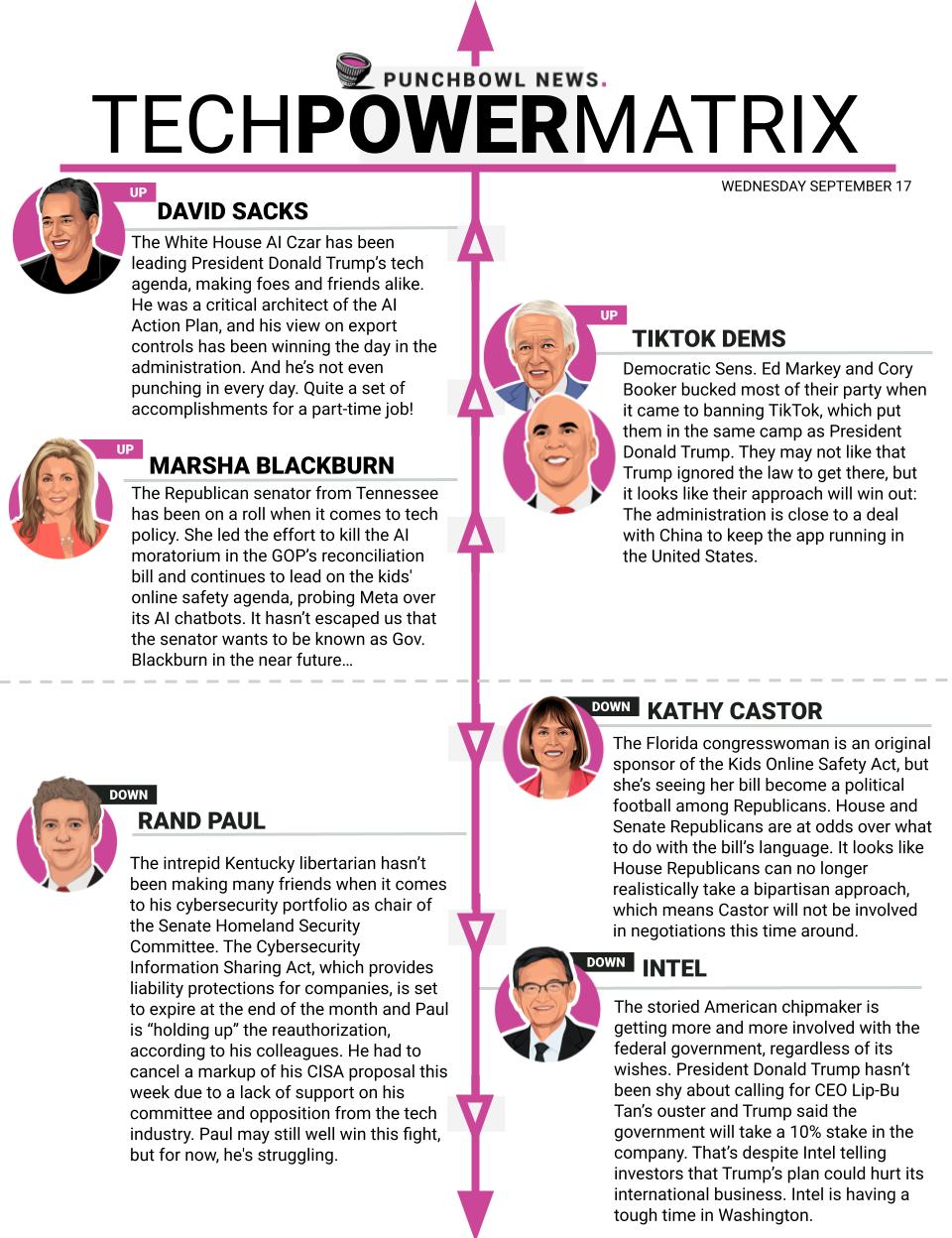
And it wouldn’t be a quarterly edition without a Power Matrix where we’ll tell you who’s up and who’s down in the tech policy battles.
Enjoy!
— Ben Brody and Diego Areas Munhoz
Interested in becoming a Premium Policy: Tech member? Get in touch with a member of our team today.
Investing in a More Connected Future
Comcast is focused on connecting millions of Americans now and into the future. With $80B invested to expand broadband infrastructure in the U.S., Comcast is actively supporting the goal of bringing broadband to everyone, including rural communities across the country. Learn more.
CHIPS AHOY!
For chipmakers, a good offense is a good defense
Perhaps no industry’s bottom line is as closely tied to the machinations in Washington right now than chipmakers who are cashing in on the AI boom.
And the industry is working hard to get the policies it wants and kill the ones it doesn’t.
For companies like Nvidia, that means working closely with a simpatico Trump administration while fighting off attempts from congressional China hawks to limit its ability to sell its products abroad due to national security concerns. The industry has both its offense and defense in high gear.
So far, chipmakers are mostly winning with President Donald Trump advancing their priorities. Congressional GOP leaders have been wary of pushing back against the administration’s pro-industry policies despite anxiety among many members that they are benefiting Beijing.
How the divide between pro-industry policymakers and cautious China hawks plays out will be pivotal for an industry smack in the middle of an AI revolution, which could reshape everything from the economy to warfare.
“What you’ve seen in the last few months is a sea change in the way that the administration is looking at the export of chips,” Rep. Jay Obernolte (R-Calif.) said. Obernolte noted that lawmakers are looking for a way to ensure U.S. leadership while keeping Beijing’s AI military goals at bay. “Everyone’s searching for a solution that balances those competing interests.”
Changing minds. When we say “U.S. chipmakers,” we certainly mean all the companies involved in the vast and complex semiconductor supply chain.
But it’s undeniable that Nvidia, which designs the most desirable AI chips, plays the leading role in the policy debate. The lobbying efforts by the world’s most valuable company are in many ways the secret to the sector’s Washington success.
We’re told by people at smaller chip companies that they often take their cues from Nvidia and also allow it to serve as a heat shield when there is blowback. The main argument put forward for allowing more exports is that it will make countries like China dependent on the U.S. tech rather than building up their domestic capabilities.
Nvidia has been busy making this point in Washington and it’s notched some pretty big wins in recent months with the help of its most prominent lobbyist — CEO Jensen Huang.
The company convinced the administration to reverse course and allow them to sell their H20 chip to China. Trump has also made huge AI deals with Gulf States that are set to boost Nvidia’s business. Inside the administration, the industry’s most influential advocate is White House AI Czar David Sacks, a veteran Silicon Valley venture capitalist.
While administration decisions benefiting Nvidia have drawn bipartisan concern on the Hill, Huang has also been working hard to get some lawmakers on his side. We’re told Huang often will sit with lawmakers for long periods of time, exhausting all of their questions and clarifying any points.
Huang has personally engaged with the House Foreign Affairs Committee, which has jurisdiction over export controls, and was on the Hill in July to meet with lawmakers when he was in town.
Here’s what one GOP senator told us about meeting with Huang:
“He has this very understated way about him, he’s not a back slapper. Most people aren’t comfortable with silence, he is. He’s just gonna look at you, he’s gonna stick around as long as he can and just go through it.”
Hearts left to sway. Despite the charm offensive, Huang and other CEOs in the chip industry are dealing with a barrage of legislation from the Hill.
As we reported Sunday, there are a series of proposals in Congress that have caught the attention of the tech industry.
Most notably, Sen. Jim Banks’ (R-Ind.) GAIN AI Act has been top of mind. The proposal, which is a provision in the Senate’s annual defense policy bill, would require chipmakers to give American consumers first dibs on AI chips before they’re sent to “countries of concern” like China.
Many observers in the industry and in tech policy circles interpreted GAIN AI as a congressional response to the administration’s export control policy. Banks, wary of appearing to be picking a fight with Trump, has emphasized that it’s an “America First” proposal and not meant to counter the administration’s moves.
China hawks, including Trump ally Steve Bannon, who’ve been frustrated with the administration giving Nvidia and AMD the chance to sell AI chips to China, are cheering on Banks.
The fate of Banks’ GAIN AI proposal will tell us a lot about whether the hawks have a fighting chance against an industry enjoying a lot of success in Trump’s Washington.
– Diego Areas Munhoz and Ben Brody
ONLINE SAFETY
The new (and old) online protection debates heat up

A year ago, lawmakers were trying to use the closing months of the 118th Congress to pass a variety of protections for online consumers.
Now, members of Congress are seeing if they can pick up the pieces of all those failed efforts and put together legislation that can become law.
There are efforts to protect kids on social media, address privacy concerns and improve data protection for teens, along with new ideas that lawmakers weren’t even considering in 2024.
Here’s where lawmakers stand as they look to advance online consumer measures this fall — plus, what they’re up against.
KOSA. The Kids Online Safety Act would limit certain social media design features like autoscroll in a bid to protect kids and teens. The popular bill sailed through the Senate last year. But House Republican leaders killed it over worries that the bill was a Trojan horse for censorship against conservatives.
Now, KOSA is working its way back. The lead House Republican on the measure, Rep. Gus Bilirakis (R-Fla.), told us recently he has a new version ready for feedback.
Bilirakis and, more importantly, House Energy and Commerce Committee Chair Brett Guthrie (R-Ky.) said they want a bipartisan product, like the version of KOSA that passed the Senate last year.
That will be tough to achieve. The price for House GOP leadership’s support will likely be striking legal liability protections for tech firms from the bill. But Democrats are sure to push to keep that provision in the bill to secure their side’s support for the proposal.
Meanwhile, senators who have championed KOSA have little interest in the changes House Republicans are discussing. They said Congress should enact the version of the bill that passed the Senate last year on a 91 to 3 vote.
Kids and App Stores. A new policy push this year would require phones, laptops and other devices to verify users’ ages as a part of an effort to block kids from mature apps or websites.
We’ve reported that Guthrie’s panel is considering including the proposal among a set of digital consumer protections he could bring forward in the next few months.
This issue has gotten some momentum in recent days with the California legislature putting a hardware-level age-verification bill on Gov. Gavin Newsom’s desk. Similar laws have sprung up in other states. So has a congressional version that focuses on smartphones.
Several tech companies have gotten behind the California bill or similar approaches. That includes big names like Google, Meta, Snap and Pinterest. Others in the industry, such as the Big Tech trade group NetChoice, have all but sworn to fight age verification laws.
Comprehensive privacy. For many lawmakers, one of the greatest disappointments of last year was another failure to pass online privacy protections for all users, not just kids and teens.
We’re not exactly bullish on the prospects of progress on this front this year, but we’d like to bring you some news on where things stand.
We’ve told you the Energy and Commerce panel’s Republican-only working group has started meeting at the member-level to hash out ideas for privacy legislation. Now we’ve found out what they’re talking about.
Rep. Jay Obernolte (R-Calif.), a member of the working group, said the first member-level meeting focused on what areas the federal government should take the lead on over states in enacting and enforcing laws.
Longtime privacy watchers will recognize preemption and enforcement as the two thorniest, most intractable issues year after year. Preemption, in the context of artificial intelligence, has also become controversial these past few months.
There’s also an effort on privacy in the Senate Judiciary Committee focused on intellectual property, though we’d call it very preliminary.
We’ll see if any of this can break through this Congress.
— Ben Brody
PRESENTED BY COMCAST
We extended our network to over 1.25 million new homes and businesses just in the last year and are on track to do the same this year. Learn more.
DON’T MISS THIS
ICYMI: The latest on AI, KOSA and cyber
Below is the best of our recent reporting on a range of issues dominating Capitol Hill, including the chips export debate and protecting kids online. Have a look.
GAIN AI. If you need to catch up on the “America First” restrictions for chips exports that are tucked into the Senate’s version of the annual defense policy bill, we’ve got you covered. Also, this story, one of several scoops we’ve had on the topic, explains the wider world of chips proposals that the industry is worried about.
KOSA. Lawmakers are turning back to the Kids Online Safety Act — a measure that’s supposed to protect kids and teens by regulating social media design. In this story, we lay out the details on what House KOSA supporters are doing to get their bill moving, as well as the obstacles they still face.
CISA. Time is running out to reauthorize a cybersecurity law that gives companies liability protections when sharing cyber-threat data with the government. This item dives into the angst the industry is starting to feel ahead of a deadline later this fall. At the heart of the bicameral and bipartisan disagreements is Senate Homeland Security Committee Chair Rand Paul’s (R-Ky.) desire to attach language to the bill that would prevent the government’s leading cybersecurity agency from getting involved in thwarting disinformation online.
Sacks. Perhaps you’ve heard that White House AI adviser David Sacks will be hanging around the administration longer than expected. You’re welcome.
Intel. Are congressional Republicans excited about President Donald Trump’s plan to have the government take a stake in Intel and possibly other companies? They’re not.
— Ben Brody
PRESENTED BY COMCAST
Investing in a More Connected Future
Comcast is focused on connecting millions of Americans now and into the future. With $80B invested in our network and infrastructure over the last ten years, more than 125,000 employees nationwide, and 64 million homes and businesses reached, we’re building a stronger, more connected future. Learn more.

Editorial photos provided by Getty Images. Political ads courtesy of AdImpact.
The 340B program is supposed to help vulnerable patients—but without strong safeguards, it’s siphoning away funds that could be used for free and charitable medicine. The 340B Rebate Model Pilot improves program integrity, preventing duplicate discounts and strengthening accountability. Urge HHS to implement the pilot today. Learn why it matters.
Crucial Capitol Hill news AM, Midday, and PM—5 times a week
Join a community of some of the most powerful people in Washington and beyond. Exclusive newsmaker events, parties, in-person and virtual briefings and more.
Subscribe to Premium
Special Projects
Explore our deep dives into the issues that matter the most today and will shape tomorrow's future, with expert reporting that goes beyond the headlines and into the heart of the Capitol.
Check it outEvery single issue of Punchbowl News published, all in one place
Visit the archiveThe 340B program lacks transparency—making it hard to tell if it’s actually helping vulnerable patients. HHS can fix the problem by implementing the 340B Rebate Model Pilot, ensuring the program is transparent, compliant, and accountable. Learn more.