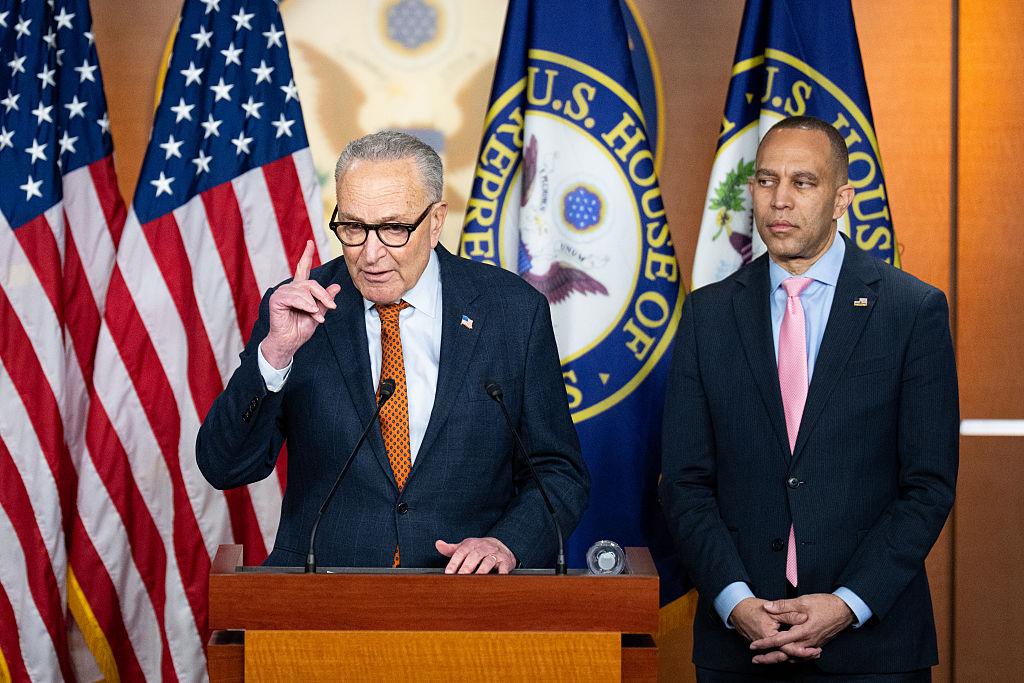
Crunch time. Democratic leaders rejected a White House counteroffer on DHS reforms in a late-night statement on Monday, complaining that the GOP proposal “included neither details nor legislative text.”
Earlier Monday, Senate GOP leaders were trying to lay the groundwork to pass another short-term DHS funding patch. They were working closely with the White House to convince enough Senate Democrats that negotiations are on the right track as Friday’s shutdown deadline looms.
But the joint statement from Senate Minority Leader Chuck Schumer and House Minority Leader Hakeem Jeffries made clear that persuading even a small handful of Democratic senators to support a stopgap measure will be a heavy lift.
“The initial GOP response is both incomplete and insufficient in terms of addressing the concerns Americans have about ICE’s lawless conduct. Democrats await additional detail and text,” Schumer and Jeffries said.
Senate Majority Leader John Thune has been striking an unmistakably optimistic tone about the negotiations, knowing that’s the key to securing enough Democratic support for a short-term funding patch. The exchange of offers was a sign that there’s some level of horse-trading going on as the deadline nears.
“Obviously there’s a lot of work ahead but I think the sides are engaged in good-faith efforts at trying to find common ground,” Thune said. “[Democratic support] depends on how well the negotiations are going and whether it looks like there’s a pathway to success. And based on what I’m familiar with about the discussions so far, I think there is.”
The political dynamics. The White House is incentivized to say these are serious negotiations, even if most Hill Republicans doubt that they can reach a final accord with Democrats — or want to. For their part, Democrats want to look like they’re working hard to secure their priorities without shutting down DHS, a massive department of 260,000-plus employees.
Plus, everyone wants to resolve this by Thursday night, when dozens of senators are scheduled to head to the Munich Security Conference and other CODELs ahead of a weeklong recess.
It’s in Thune’s interest to facilitate a process Democrats can feel good about, especially amid pressure from progressives opposed to DHS funding. Thune will need around eight Democratic senators to vote for a short-term funding patch.
Senate Minority Whip Dick Durbin, who voted to end or avert previous shutdowns, said that evidence of “real, honest negotiations” can prompt enough Democrats to support a short-term continuing resolution for DHS.
Sen. Jacky Rosen (D-Nev.), who voted to end the 43-day government shutdown last year, told us she could support a short-term CR if there’s progress on applying “guardrails” to ICE agents’ conduct.
“What I want to see is the same rules, guardrails that our FBI go by and that our state and law enforcement go by,” Rosen said.
We asked Jeffries about whether he thinks Republicans are serious about cutting a deal. Here’s what he said, in part:
“It’s clear to me that House, Senate Republicans and the White House, they’re all on the run. These people are falling apart. They’re losing election after election. They’ve lost the public. Donald Trump is at historically low approval ratings … And so our view is dramatic reform is necessary with respect to DHS before a funding bill moves forward.”
MAGA muscle memory. Even as they attempt to cut a deal with Democrats, Thune and GOP leaders are facing renewed pressure from the right not to make a deal. Republican senators closest to the MAGA movement, most notably Sen. Eric Schmitt (R-Mo.), are urging Republicans to reject Democrats’ demands and push for policy priorities of their own.
“More and more Republicans see that it’s not smart for us to be capitulating to Democrats on core issues like taking on illegal immigration,” Schmitt told us. “This is a core issue for the coalition that allowed us to have these majorities.”
There’s even some resistance to a short-term funding patch that’s solely for the purpose of allowing more time for a negotiation. Conservatives like Schmitt don’t believe it’s necessary.
“I don’t think that adding two weeks or three weeks for quote-unquote continued negotiations on something that we’re not gonna just agree to their demands — if anything, I think our position will harden,” Schmitt added.
Thune is planning to take initial procedural steps on the floor later today for a DHS CR. The duration of the funding patch will be subject to negotiation, Thune added. Sen. Markwayne Mullin (R-Okla.), a member of Thune’s leadership team, said GOP leaders prefer a four- or six-week extension.
“Let’s do a CR that actually matters. Another two weeks probably isn’t gonna get there,” Mullin said. “But if they want to keep hodgepodgeing two weeks at a time, I guess we’ll do whatever we have to.”