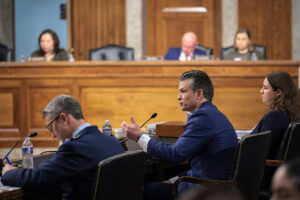



Defense Secretary Pete Hegseth is walking into a changed Capitol Hill arena than the one he faced just two weeks ago.
Now, the U.S. war with Iran is “terminated” (at least according to President Donald Trump), the Pentagon is drawing down American forces from Germany and congressional frustration is growing over the slow release of Ukraine aid.
The Iran declaration, which is sure to face open skepticism amid the tenuous state of the ceasefire, underscores the urgency over when the Pentagon will formally seek funding to cover the conflict.
House and Senate appropriators will have a chance to press Hegseth and Joint Chiefs of Staff Chair Gen. Dan Caine on the timing and need for that package on Tuesday.
Acting Pentagon Comptroller Jay Hurst said two weeks ago that DOD plans to send a supplemental to Congress once it has a full assessment of the Iran war costs, which at the time were around $25 billion. The White House tells us a supplemental request isn’t imminent.
“We’re working on it,” Sen. John Hoeven (R-N.D.), a senior appropriator, said of an Iran supplemental. “They still need the money just for what they spent on the war.”
But time is short, and every day the White House and Pentagon wait to submit a request puts pressure on the already tight congressional calendar. Lawmakers continue to say they’ve heard little detail from the administration about the supplemental request. A final package will almost certainly include money to refill munitions stocks, cover operational expenses and repair U.S. bases damaged by Iranian attacks.
But the Trump administration has hinted that it could reconsider its long-term force posture in the region, raising questions about how much money officials will seek to repair damaged facilities. Appropriators haven’t received any information on DOD’s basing plans, a senior Senate GOP aide said Monday.
Democrats aren’t holding their breath for real answers to the cost of the war.
“He’s there to put on a performance for the leader,” Sen. Chris Murphy (D-Conn.) said of Hegseth and Trump.
Spotlight on Europe. Lawmakers from both parties will almost certainly press Hegseth on the status of $400 million in aid for Ukraine, funding that the Trump administration has slow-walked in releasing.
The FY2027 budget request doesn’t include additional defense support for Kyiv or the Baltic states of Estonia, Latvia and Lithuania. The initiatives were a big priority for appropriators last year.
The absence of funds will be a focus for Sen. Chris Coons (Del.), top Democrat on the Defense Appropriations panel. Coons demanded to know why Hegseth “again submitted a budget that cuts all support” to those nations.
Look for lawmakers to press for answers about the administration’s decision to remove 5,000 troops from Germany as well, a move that’s drawn bipartisan criticism and happened just days after Hegseth’s last Hill appearance.