Government funding update. The battle over government funding has turned into this: Each side claims they’re being completely reasonable while blaming their opponents for the looming showdown.
Yet with less than two weeks to go before the funding deadline, Republican and Democratic leaders are growing further apart rather than closer. Both sides seem content to stand pat, even if that leads to a government shutdown on Oct. 1 and a broader political crisis.
Let’s be clear: A shutdown with President Donald Trump in the White House and Republicans in charge of Congress could spiral into a prolonged political stalemate. Democrats are dug in on health care-related demands, and they won’t move unless Republicans negotiate. The Republican leadership is telling its rank-and-file that they won’t negotiate on a seven-week CR. Any deal will be that much harder to reach once a shutdown takes hold.
House and Senate Democrats introduced a month-long funding proposal Wednesday night that would keep the federal government open until Oct. 31. The Republican plan extends funding until Nov. 21.
Democrats are calling for the permanent extension of enhanced Obamacare premium tax credits, in addition to the reversal of huge Medicaid cuts from the One Big Beautiful Bill. Democrats also want to bar any future rescissions and restore public-broadcasting funding.
The price tag for these provisions is hundreds of billions of dollars, a massive amount on a short-term stopgap funding bill. And nearly every provision in this package is a non-starter for Republicans.
Senate Majority Leader John Thune compared Democrats’ position to “hostage-taking” — an oft-stated Schumer line from past shutdown fights.
Schumer countered that Democrats were open to bargaining, if only Republicans would call them.
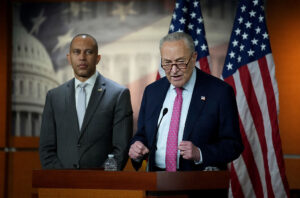
“We’ll sit down and negotiate if they will sit down and negotiate,” Schumer told reporters on Wednesday night. “We don’t have a red line, but we know we have to help the American people. We know our bill does. We know the American people will reject the status quo embodied in the Republican bill.”
Schumer added: “We have two weeks. We should sit down and maybe we could get a good proposal. We’ll see.”
The veteran Senate Democratic leader faces serious doubts from his House Democratic counterparts over whether he’ll fold in this situation. House Democrats look back to Schumer cutting a deal with Republicans in March and worry it could happen again.
To be clear, Republicans simply have no interest in negotiating. They feel like Democrats felt in the past: Negotiating under these circumstances is validating the Democrats’ position. Republicans are comfortable saying that they’ve proposed a clean CR, which is what Democrats usually ask for, to buy time for bipartisan full-year FY2026 funding talks.
When we caught up with Speaker Mike Johnson Wednesday, we asked him about what would happen if the Democrats wanted to negotiate after the government shut down.
“’I’m going to present, again, a clean, short-term CR,” Johnson said. “That is the only way out of this.”
House Floor Friday. The House Republican leadership will most likely put their seven-week, stopgap government funding bill on the floor Friday morning.
Will it pass? Probably. Because Trump wants it to. House Republicans mostly do what Trump wants. Rep. Thomas Massie (R-Ky.) is still a no. So Johnson can probably spare one more vote. Forgive us if we aren’t giving enough credit to the few rank-and-file Republicans who are saying they’ll vote no. They always fold under Trump pressure.
Several House Republican leadership sources told us late Wednesday that the vote count is moving in the right direction. But Friday is a long way off. Members of the House Freedom Caucus and other GOP lawmakers wanted Johnson to stick to his 72-hour rule for this bill, so Johnson is.
To be frank, it makes sense for Johnson to hold out until Friday. It’s very annoying, of course, and it slows the Senate down. But why give any of his members a reason to vote no? In a position like this, he’s trying to eliminate GOP defections.
Checking in on Senate Democrats. Senate Democratic leaders are vowing to oppose the House bill. But what about the 10 Democratic senators who paved the way for the March CR?
Schumer needs his caucus to stick together in order to bring Republicans to the negotiating table. All indications are that Schumer will be able to filibuster any GOP CR.
“If they don’t want our help, then they’re not going to get our help,” said Sen. Brian Schatz (D-Hawaii), who voted for the March CR.
But some of the Democratic senators who backed the March bill are leaving the door ever-so-slightly open to backing the seven-week stopgap, especially if it’s the only hope for averting a shutdown.
“I think we have to see what happens,” Sen. Jeanne Shaheen (D-N.H.) said. “I would hope that [GOP] leadership would talk to Democrats.”
“I’ll consider all options, but they ought to do the tax rate,” added Sen. Angus King (I-Maine), referencing Obamacare enhanced premium tax credits.
If anything, the equivocations reflect a desire to avert a shutdown at all costs. But beyond Sen. John Fetterman (D-Pa.), we don’t expect any Democrats to cross Schumer and back the GOP CR.
“I don’t know how many votes will be there to keep the government open on my side, other than just mine, honestly,” Fetterman said.