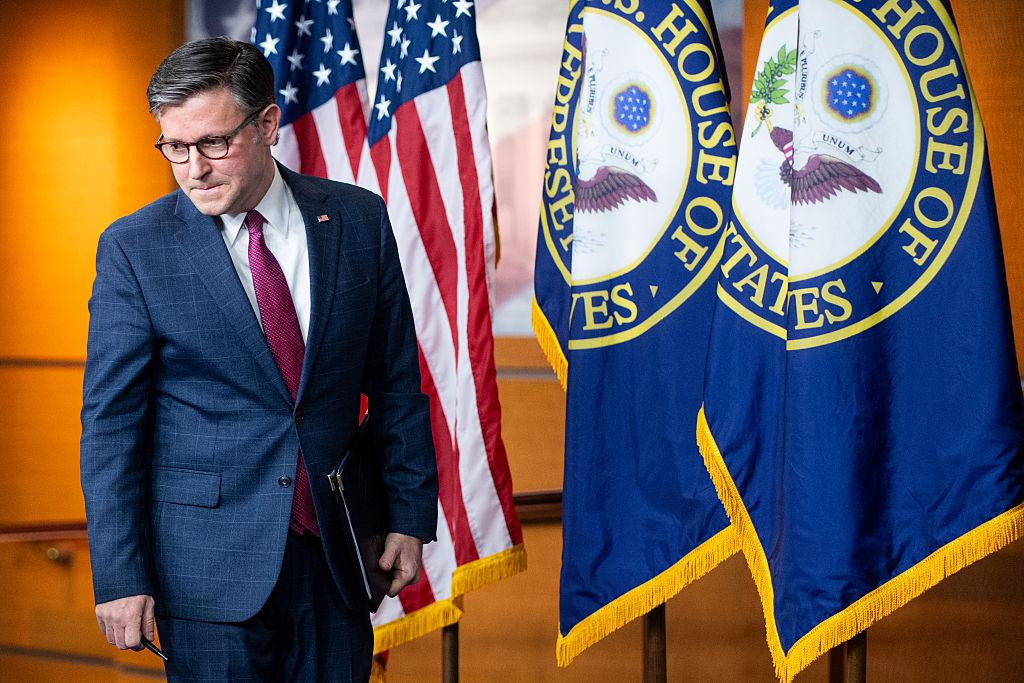
This week — the last of the legislative year — was designed to give House Republicans a way to push back on Democratic attacks that they’re indifferent to skyrocketing health care costs hitting millions of Americans.
Instead, the House GOP leadership has facilitated an untimely — and particularly nasty — intraparty brawl, pitting moderates against Republican Party leaders and further strengthening Democrats’ political hand as the Obamacare cliff looms.
Speaker Mike Johnson and his inner circle are pushing moderate Republicans like Reps. Brian Fitzpatrick (Pa.), Mike Lawler (N.Y.), David Valadao (Calif.) and Jen Kiggans (Va.) into the arms of Democrats, as the House Republican leadership refuses to allow the centrists a vote on extending the enhanced Obamacare premium subsidies.
During a closed GOP leadership meeting Monday, top House Republicans ruled out giving the moderates a waiver to pursue their amendment without steep budgetary offsets. No one in the room pushed back, according to multiple sources present.
Without an Obamacare subsidies extension, the Republican leadership is simply allowing House members another chance to vote on a suite of policies on which they’ve previously voted.
The GOP package this week is effectively warmed over health care provisions that the Senate has already rejected. Rank-and-file Republicans don’t even get the benefit of politically jamming Democrats, who’ve voted against these policies once and will gladly vote against them again.
The House GOP leadership’s reason for snubbing the majority-making moderates: party rules mandate that the amendment needs to be offset by spending cuts or other savings. Republican leaders even suggested to the group of moderates that they sequester Medicare funding to help pay for the subsidies. The bottom line is the pay-fors would’ve made the amendment unpalatable for the Republican centrists.
It’s now possible that some Republican moderates will sign onto House Minority Leader Hakeem Jeffries’ discharge petition. Jeffries’ petition — which already has 214 Democratic signatures — forces a vote on a three-year extension of the Obamacare subsidies. This position was once anathema to every single House Republican.
However, Kiggans ruled out signing Jeffries’ petition, according to a source familiar with her thinking. That takes one potential GOP backer off the table, but it’s still a big shift that Kiggans felt the need to consider and say no to this route.
Advantage Democrats. By refusing an amendment vote on extending the Obamacare subsidies, consider the political advantage Republicans have delivered to the Democrats.
If four Republicans sign Jeffries’ discharge petition to extend the ACA subsidies, Democrats have exacted the precise policy win they’ve been seeking, even if that never becomes law.
Alternatively, Jeffries can urge Democrats to sign Rep. Josh Gottheimer’s (D-N.J.) petition for a one-year extension with income caps. This would give Democrats a modest policy win — a shorter-term extension of the subsidies — and place the new expiration date smack dab in the middle of an election year. Gottheimer’s petition currently has 40 signatures.
Either way, Congress will go over the Obamacare cliff and allow the boosted tax credits to lapse Dec. 31. That will raise health care costs for millions of Americans nationally. Politically, it’s Republicans who will take the hit.
Two flashpoints today:
1) The House Republican Conference will meet at 9 a.m. We’ll be watching to see if there are any flare-ups with moderates sounding off about the GOP leadership’s unwillingness to give them a vote on the Obamacare subsidies. We spoke to several moderates on Monday evening who were quite worked up about this decision
2) The House GOP moderates are expected to go to the Rules Committee this afternoon at 2 p.m. in a bid to get floor consideration for their Obamacare subsidies amendment. The speaker-controlled panel will almost certainly reject that request, infuriating the centrists and pushing them toward the discharge petition.
For what it’s worth, the GOP moderates still plan to vote for the underlying Republican health care bill even if it doesn’t include the Obamacare subsidy extension.
The Senate re-enters the chat. A bipartisan and ideologically diverse group of more than 20 senators met for nearly two hours in the Capitol late Monday. This comes after the Senate rejected extending the Obamacare subsidies last week.
The senators discussed a possible agreement revolving around a proposal from Sens. Bernie Moreno (R-Ohio) and Susan Collins (R-Maine) to extend the Obamacare subsidies for two years with income caps and other reforms.
Senators from both parties emerged from the meeting exuding a positive attitude about the outlook for a deal in January — which is after the Obamacare subsidies expire. Some even mused about releasing a framework this week for a potential compromise.
Of course, a deal is unlikely. And the Hyde Amendment remains the biggest obstacle to an agreement that can get 60 votes.
“There has never been a proposal on health care that Republicans have supported that allowed for taxpayer dollars to be used for abortion purposes,” Sen. Mike Rounds (R-S.D.) said. “That is still a major issue.”
At the same time, allowing the Obamacare subsidies to expire without a replacement could be politically treacherous for Republicans.
“This is a really serious issue for great Alaskans who are going off this cliff through no fault of their own,” added Sen. Dan Sullivan (R-Alaska), who’s up for reelection in 2026.