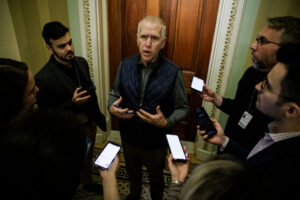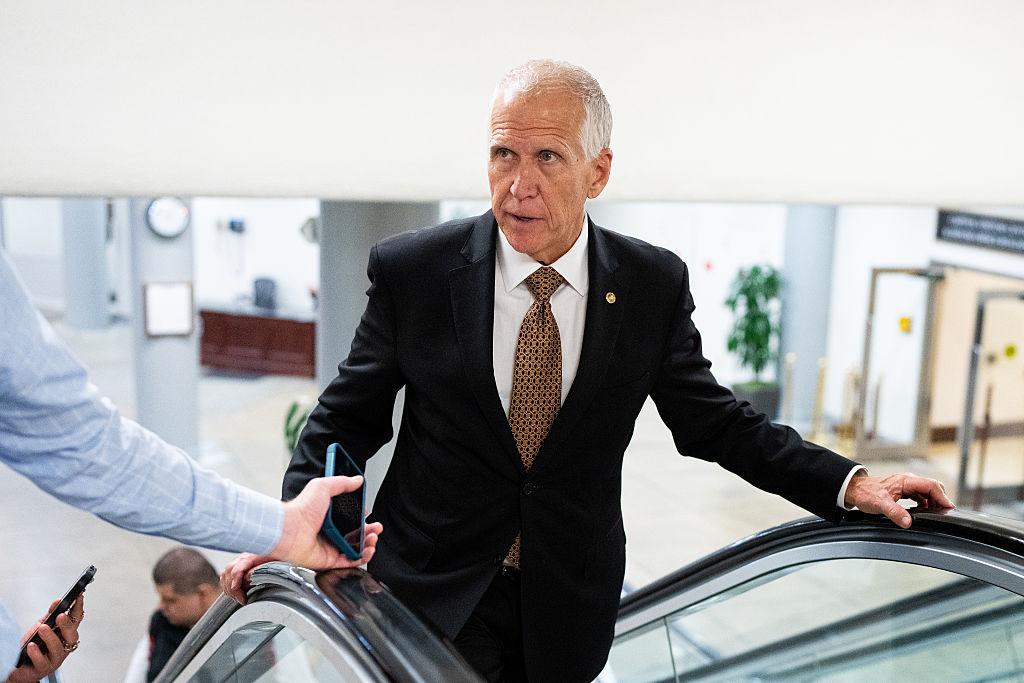
In an era of overwhelming GOP deference to President Donald Trump, Sen. Thom Tillis (R-N.C.) reminded his colleagues that they have more power than they think — or care to use — to rein in the White House.
More often than not, fear of an angry Trump comment or Truth Social post is the main consideration among GOP lawmakers. Tillis has gotten his fair share of those. He’s also not running for reelection, an announcement Tillis made following a showdown with Trump and Senate Republican leaders on Medicaid cuts last year.
But Tillis’ victory over Trump’s efforts to criminally target Fed Chair Jay Powell and undermine the central bank’s independence provided a blueprint for GOP senators looking to use their unique power to check White House behavior.
“Some of our members just randomly put holds on [nominees] and they have no way out. They shouldn’t go into a box canyon,” Tillis said in an interview. “You want to be judicious. And you need to be in a position to follow through. I’m really using it, in many cases, for things that I think most of my colleagues are OK with.”
Tillis, who’s the deciding vote in the Senate Banking Committee, used that leverage to block all Fed nominees until the Justice Department ended its criminal investigation into Powell. Tillis made clear that this was the only way for Trump to win Senate confirmation for Kevin Warsh, his pick to replace Powell.
It worked. Unlike the blanket holds senators often deploy, Tillis’ blockade was narrow and focused, making it more likely to succeed.
The politics. Senate Republicans are publicly thanking Tillis for exercising his leverage in ways they themselves believed they couldn’t. It’s a recognition of the political risk Republicans face when standing up to Trump, especially on a big issue like this.
“He’s not running for reelection, and [Tillis] saw the opportunity to address it where nobody else had to,” said Sen. Mike Rounds (R-S.D.), who’s on the ballot this year. “I appreciated the fact that he stepped in at that point and was insistent that we resolve this issue, because a number of us felt the issue needed to be resolved.”
Tillis often reminds reporters that he deployed these leverage plays even before announcing his retirement. For example, Tillis tanked Ed Martin’s U.S. attorney nomination over Martin’s posture toward the Jan. 6 Capitol riot.
Tillis acknowledged that his Fed move would’ve been risky for most other Senate Republicans, but he said the worsening political environment for the GOP may force some Republicans to show separation from Trump.
“Every single member has a unique relationship [with Trump]. And I like to think that some of mine is built on mutual respect,” Tillis said. “We’ve got to be willing to say, ‘I’m not doing this to hamper the president’s legacy. I’m actually doing it to improve it.’”
Inside the Warsh blockade. In this case, Tillis was speaking for more than just himself. That included Senate Majority Leader John Thune.
“We want to get things done around here, and sometimes you have to work around individual members… We do that every day,” Thune told us. “But this was an example of one where [Tillis] held his ground and ultimately this was, in my view, the right outcome.”
These kinds of blockades are usually among the more frustrating things a party leader has to deal with, but Thune used this one to his advantage. Thune’s public comments throughout the saga showed he was trying to leverage Tillis’ roadblock to push the administration to drop the Powell probe. It was successful, and Thune was shielded from the political fallout.