

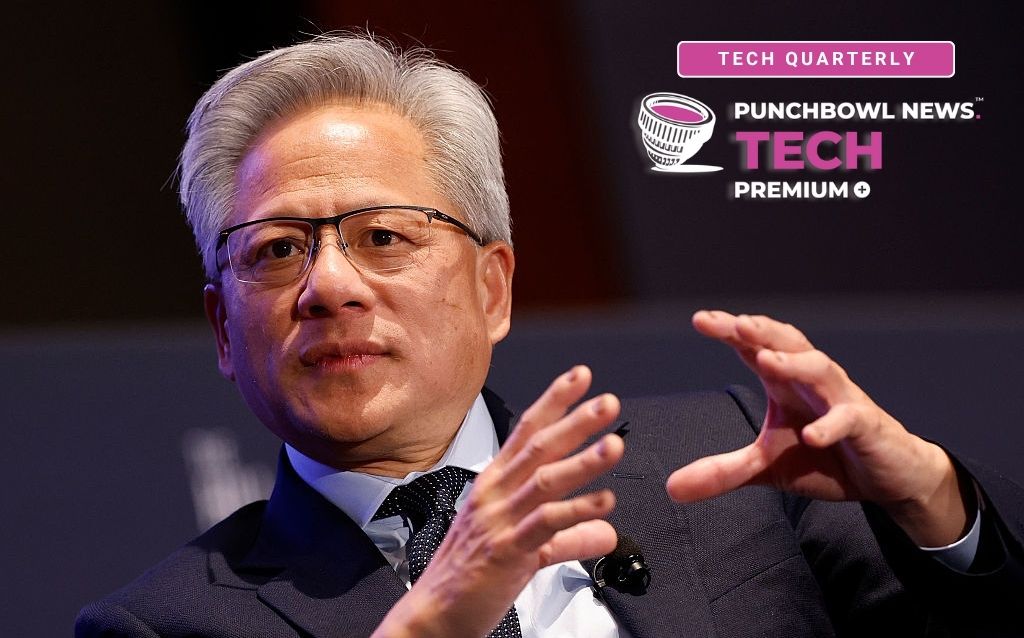
SAN JOSE, Calif. — During Nvidia’s GTC conference earlier this month, CEO Jensen Huang spoke to an arena full of screaming fans, including some wearing his face on their t-shirts.
But there is an audience Huang is even more focused on capturing and it resides in the nation’s capital.
“No institution has more directly affected Nvidia’s global position than Washington, D.C.,” Huang said in an interview at the company’s conference last week.
Huang has built a $4 trillion AI chip empire that started in 1993 with a focus on gaming. Navigating Washington is proving just as challenging.
Nvidia is central to one of the key economic and foreign policy issues of the moment: Does the path to dominating AI run through keeping our tech away from China or making Beijing reliant on American innovations?
It’s a difficult question and one that is dividing Congress into China hawks and AI enthusiasts. Count Huang firmly in the pro-reliant camp, and he has the ear of President Donald Trump.
We talked about all things Washington with Huang. Here’s what we learned.
Huang’s pitch. The United States can succeed by keeping Chinese developers dependent on American tech and competing with China’s chipmaker Huawei, Huang said.
That would ensure Beijing is reliant on the United States for AI chips, just like America depends on China for manufacturing in other industries.
Huang argues that in the global race to dominate AI, everyone will be a player in developing models that can change how we work and live. The United States, China, Europe, you name it. But where America can set itself apart is the technology that underpins those models: chips.
“We should just run all models,” Huang said. “You should always win from the foundation up.”
But key players in Washington fundamentally disagree. Foreign policy hawks argue doing more business with Beijing on any aspect of AI is a path to economic and national security ruin.
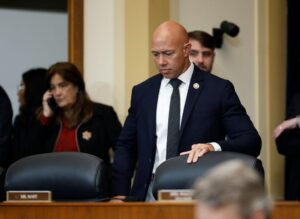
“I wouldn’t sell them a bullet,” House Foreign Affairs Brian Mast (R-Fla.) said.
Legislative laments. Several bills floating through Congress challenge Huang’s view of the AI race — and it’s a view he has successfully gotten Trump to embrace. Nvidia is selling chips to China with the administration’s permission, which has many on Capitol Hill reaching for the Rolaids.
Mast is pushing a bill that looks to reverse or slow those exports. The AI Overwatch Act would treat AI chip exports like military arms sales and give Congress the ability to block export licenses issued by the Commerce Department.
Huang is not amused. He said the bill would supersede the president’s power over export controls.
AI “is unlike a fighter jet,” the Nvidia CEO said. “These are just fundamentally two different things and so comparing it makes absolutely zero sense to me.”
Senate Intelligence Committee Chair Tom Cotton (R-Ark) and Rep. Bill Huizenga (R-Mich.) want to require a tracking mechanism for chips sold abroad to crack down on smuggling.
“Nothing would kill the American technology industry faster,” Huang said. He added that any type of tracking feature should be voluntary. The U.S. government can leverage its licensing process to pressure customers to employ tracking features, Huang said.
Huang said the previous export controls employed by the government fueled smuggling, which he described as representing a “little tiny bit” of the total AI trade. Huang argued that diverted products aren’t enough for a data center buildout “at scale.”
“If they could do it properly, why would they smuggle?” Huang said.
‘Doomers.’ Huang attributed much of the opposition to Nvidia’s policy agenda to “AI doomers,” or people who advocate a cautious approach to AI given its potential societal and economic impact.
“They are incredibly well funded and they strike fear,” Huang said. “The AI doomers are investing tremendously in influencing to the point of almost controlling many areas in Washington, D.C.”
The “doomers” are a frequent target of most of the AI industry. The most prominent entity receiving this label is Anthropic, the AI model giant that emphasizes safety precautions when deploying the technology’s power.
The challenge for Huang and his industry peers is that the political picture is much blurrier than a simple AI boomers vs. AI doomers dichotomy.
Republicans who advocate for strong AI regulation, such as Sens. Marsha Blackburn (Tenn.) and Josh Hawley (Mo.), don’t tend to engage in the export control debate. Their concerns lay mostly with the technology’s societal impacts in areas concerning kids and copyrights.
Then there are key lawmakers like House China Committee Chair John Moolenaar (R-Mich.) and moderate Democrat Josh Gottheimer (N.J.) who advocate for “light-touch” AI regulation domestically but strong export controls.
And then you have Democrats like Rep. Ro Khanna (D-Calif.), who side with Nvidia on selling chips to China but want strong AI safety guardrails.
Navigating these conflicting factions isn’t easy, but Huang remains optimistic.
Any lawmaker who wants his phone number can have it, Huang said. Huang will remain “non-partisan” and won’t engage in campaign spending like many of his tech industry peers.
After all, Huang said, Washington and Nvidia share the same goal: winning the AI race.
“We both want America to be rich, I believe that, I believe they do and so my doors are wide open,” Huang said.