PRESENTED BY

THE TOP
The tech battles won’t slow down in 2026
Welcome to our Punchbowl News Tech Quarterly Edition!
This was an unforgettable year for tech policy, and 2026 won’t be any less significant.
Here at Punchbowl News Tech, we’ve taken you through the major developments over the past 12 months:
— The drama over export controls on artificial intelligence chips.
— The fight over whether to block state AI laws.
— The spectrum battles.
— The debate over how to protect kids against online harms.
— The cybersecurity policy conundrums.
Many of these fights will carry on into 2026. Chips keep getting better and better, and companies like Nvidia will keep pushing against curbs on sales to China. President Donald Trump’s preemption executive order will likely become a high-profile legal fight as states push to regulate AI.
And the political intricacies of kids online safety legislation will only intensify next year.
On top of all that? A blockbuster midterm election in which AI boomers and doomers will be spending big to elect candidates that support their agendas.
Tech may always have been a sleeper issue in previous elections, particularly after the social media boom and its consequences in recent years.
But AI is a strong steroid shot into the tech policy debate. Voters are beginning to wrestle with data center issues and fears over jobs displacement. They’re also increasingly more familiar with the technology and many are hopeful about its promises for society.
We’ll get into how both sides of that debate are planning to fight it out in the 2026 midterms. There’s going to be a lot of cash floating around so we spoke to two people in charge of the organizations that will be spending money against each other.
Then, we dissect the latest on the kids online safety bills and what it’ll take for them to finally make it into law. Spoiler alert, it’s complicated.
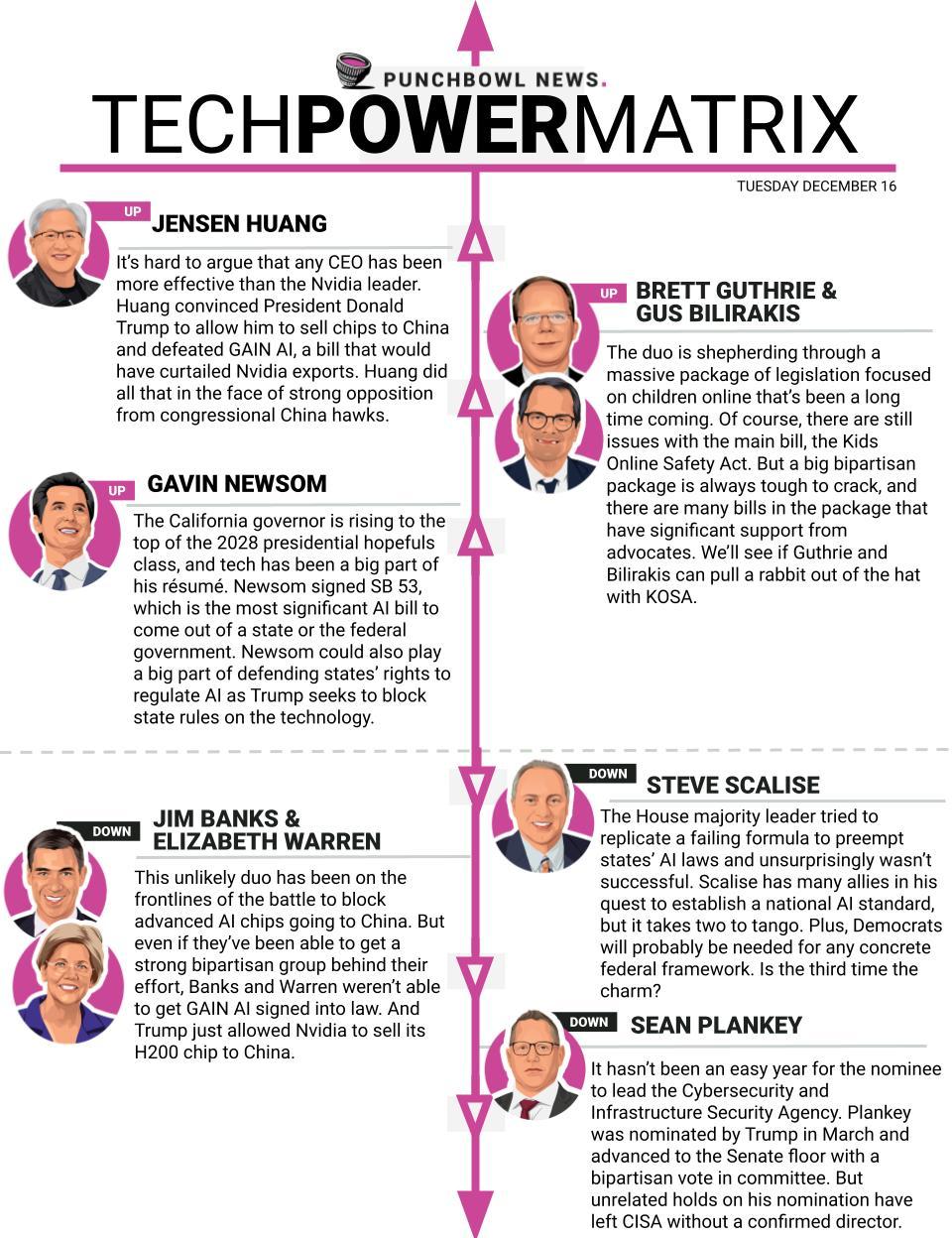
And it wouldn’t be a quarterly edition without our traditional Tech Power Matrix. We’ll go over the winners and losers of the tech battles, bringing joy to the people who are up and dismay to the people who are down.
We believe tech is the most fascinating beat right now, and we can’t wait to cover the upcoming battles next year. Thank you for reading. We’ll see you in 2026.
–Diego Areas Munhoz and Ben Brody
PRESENTED BY META

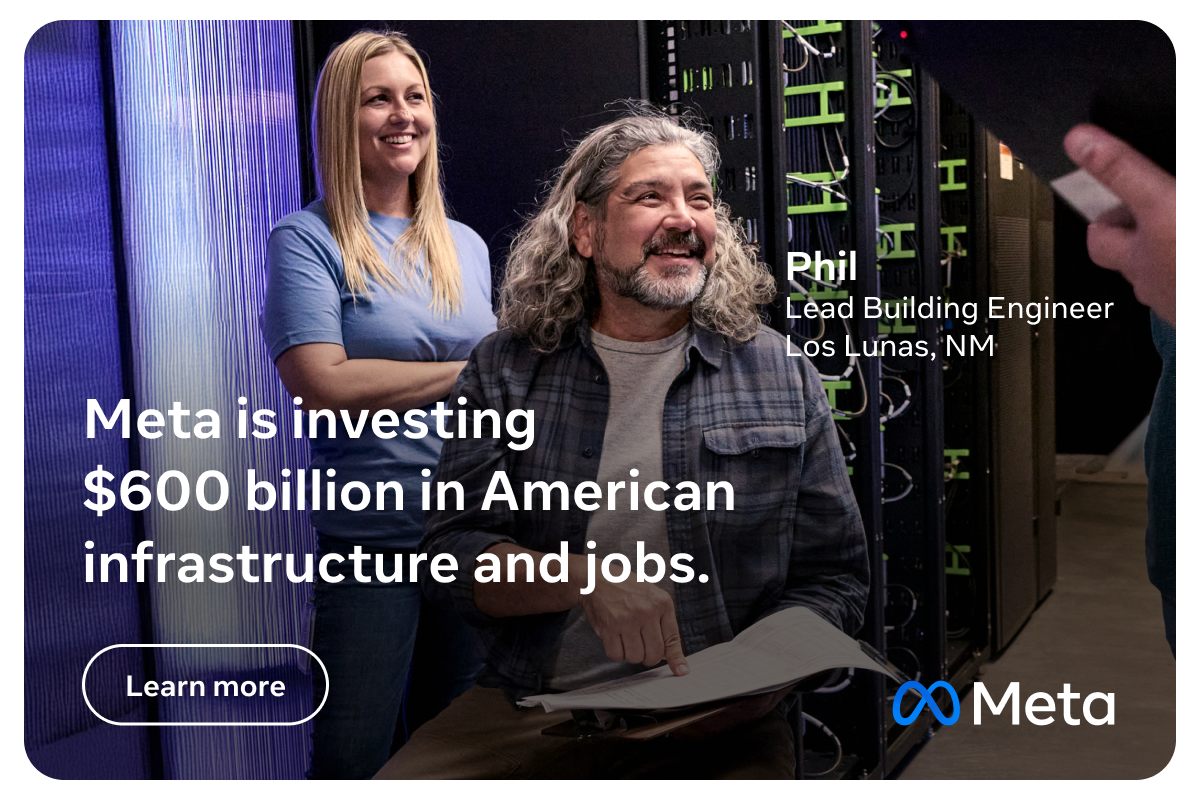
Meta’s AI infrastructure is bringing jobs to local communities.
For Phil—and many Los Lunas, New Mexico locals—supporting his family used to mean “leaving town, and missing moments I couldn’t get back.” Not anymore.
Meta is investing $600 billion in American infrastructure and jobs, creating opportunities in communities nationwide.
MONEY, MONEY, MONEY
The coming AI campaign war
The battle over artificial intelligence policy will soon move to the campaign trail.
That’s where two opposing camps plan to spend big money to elect candidates at the federal and state levels who are supportive of their vision for the transformative technology.
This dynamic echoes the crypto community’s involvement in the 2024 election, an unprecedented effort by an industry to reward its friends and defeat its enemies with oodles of cash.
The key difference here is that, unlike the crypto industry, the pro-AI campaign effort will have an opposing group fighting for the hearts and minds of voters. It’s a battle between the AI boomers and the AI doomers.
Together, the two groups are planning to spend at least $150 million between them, which is more than the $100 million the crypto industry doled out in 2024. It’s hard to overstate how influential this spending could be in key races.
The AI boomers are represented by the industry-backed Leading the Future super-PACs, while the doomers are represented by PACs run by two former lawmakers.
Let’s dig into how each plans to fight it out in the midterm elections.
Boomers. Leading the Future was seeded with money from industry leaders such as OpenAI President Greg Brockman, venture capital firm a16z and Palantir co-founder Joe Lonsdale. It’s ready to spend $100 million.
“You will see a broad consensus in Congress to have the federal government lead on creating a national, pro-AI, pro-America regulatory framework,” Josh Vlasto, who’s co-leading the pro-AI side, said of his group’s approach.
That’s a way of saying his group will support candidates who want the federal government to block states from enacting individual rules for AI, which the industry says will cripple its ability to win the AI race with China.
Vlasto said his group does want a federal standard for AI, but it will leave the specifics to its associated advocacy group. And it’s clear Vlasto’s group will spend its money to help candidates most supportive of the AI industry’s desire to block state laws.
Vlasto is also a spokesperson for Leading the Future’s crypto forebearer, Fairshake, which supported 50-plus candidates last year. Vlasto isn’t putting a cap on how many candidates his pro-AI group will support.
How is Leading the Future actually going to work as a political actor? Its first move was to announce it will spend to defeat Democratic New York State Assemblymember Alex Bores, who has pushed state AI regulation and is running for Congress.
Leading the Future is not, however, rolling out an early list of targets. Vlasto said it’s structured to be able to nimbly move into races when it senses the need.
“This is a highly dynamic moment in this policy debate,” Vlasto said. “We are built… to use our resources and bring the AI sector together to advocate for this agenda.”
Appropriately enough, the group has so far leaned into digital ad spending, which is cheaper, although it’s also bought TV spots.
As for tactics against the opposition, Vlasto would only say that he’s working hard to confront a “sophisticated, well-funded network advancing an ideological agenda to try and slow down American AI.”
Doomers. AI skeptics also plan to put a mountain of cash on the table in 2026 to combat tech companies’ narratives about regulation and the U.S.-China race to win the artificial intelligence competition.
Former Reps. Chris Stewart (R-Utah) and Brad Carson (D-Okla.) are launching two separate super PACs with a promise to raise $50 million for their effort to pump up pro-AI regulation candidates.
While the figure is half of what Leading the Future is promising to spend, the bipartisan duo is hopeful they’ll be able to fight back against Big Tech’s cash flow.
“Most people are anxious about AI. They’re not opposed to it, they’re anxious,” said Carson. He added that tech’s “accelerationist YOLO agenda” is not going to fly. Carson said his PACs will disclose their funders in the next few months.
The PACs will support candidates for the House and Senate, and they plan to announce those names next year. Carson said they’re also thinking about spending in state legislature races as well as fights for governor’s mansions.
They’ll spend on ads for TV, digital and “whatever medium is best to reach the voters,” Carson said. And their commitment is to support candidates from both sides of the aisle.
The two main issues driving Carson and Stewart’s PACs are AI regulation and export controls of AI chips going to China.
Carson said they’ll support candidates “who favor strong export controls.” Carson, who’s president of the Americans for Responsible Innovation group, has been very opposed to President Donald Trump’s decision to allow Nvidia to sell its advanced AI chips to China.
The PACs will also endorse candidates who believe the government has a role in regulating AI. That includes believing that states have a regulatory role, especially absent a federal framework.
Carson and his allies don’t consider themselves to be anti-AI. They argue that the technology needs more guardrails to flourish and best serve society.
“Big tech has lost the confidence of the American people,” Carson said. “And if the American people don’t believe in [AI], you’re going to see politicians turn against it in a very severe way.”
Correction:Â A previous version of this article misidentified Josh Vlasto as the head of Fairshake. He is its spokesperson.
– Ben Brody and Diego Areas Munhoz
CHILDREN ONLINE
What it’ll take to get kids bills done
Bills that aim to lessen the harms kids and teens face online are getting further along in Congress than ever before. For years, these efforts have been stymied by divisions on the Hill and heavy lobbying by the tech industry.
But times may be changing.
The House Energy and Commerce Committee held a hearing on a package of nearly 20 bills earlier this month and then quickly approved them during a subcommittee markup.
A full panel session will likely happen in early 2026. It’s expected to go better than a similar markup last year on just one bill that, because of concerns by House Republican leadership, signalled the end rather than the beginning of that year’s kids protection efforts.
But there are major hurdles that lawmakers will need to leap over, or sneak around, if they want to get bills enacted.
The foremost, of course, involve significant inter-party, inter-chamber tensions over the Kids Online Safety Act — the social media design regulation that’s supposed to be the centerpiece of any kids-digital package.
Here’s what else Congress will need to sort out:
App Store bills. KOSA may be the subject of the most fireworks, but we wanted to start with these bills because they could end up changing the most in the coming weeks and months.
Currently, the House panel is considering two approaches to protect young smartphone users. One bill would verify ages using government IDs or other methods. The other would let parents control more of their kids’ app usage, including tailoring it to their kids’ stage of life.
But Chair Brett Guthrie (R-Ky.) told us he’s on board with the idea of combining the bills.
“We’re going to work to” get to a unified approach, Guthrie said, “The bottom line, parents need to control what they’re children are seeing.”
To do so will involve an interesting lobbying fight.
The age verification bill is Republican-only, for instance. Parent groups came up with it, but Meta, a longtime Apple antagonist, has given the idea a boost. Opponents now cite Meta as a reason to oppose the measure. Apple CEO Tim Cook came to the Hill last week to tell lawmakers his low opinion of the approach, too.
Meanwhile, the age-categories bill is bipartisan but needs to overcome (some) parent groups’ worries that it represents a Big Tech spoiler effort.
And over in the Senate, there hasn’t been quite the appetite for smartphone age verification.
KOSA. We’ve spent a lot of time focusing on the political dynamics of this bill. The Senate supports design regulations (like limiting infinite scroll) that aim to rein in a wide range of harms while also placing a legal “duty of care” on social media platforms like Instagram. House Democrats love it.
But House Republicans have followed their leadership in focusing on a narrower range of harms and on obligations for platforms to have a plan to tackle those worries. The latter is in lieu of the legal duty, which House Republicans argue would be struck down in the courts.
Rep. Kathy Castor (Fla.), who was the Democratic co-lead on KOSA when it was a bipartisan bill last Congress, said she’s still working with Republicans.
“I’ve learned in this process, you keep pressing,” Castor said. We’ll note her list of priorities is a firm no-go for the GOP.
Of course, House Republicans may well be able to pass KOSA without Democratic votes.
That could start the process in the Senate, where support is veto-proof, but the next procedural steps aren’t clear. Staff for Senate Commerce Committee Chair Ted Cruz (R-Texas) have told us he’ll take up the bill once the House has sorted out its differences.
Chatbots, COPPA, etc. We’ll flag a few other items to follow. Concern about chatbots’ effects on kids is a fast-moving issue. That doesn’t mean there’s one central approach.
The push to extend existing kids-digital privacy rules to teens has also run into issues similar to KOSA. Sen. Ed Markey (D-Mass.), who led on both the kids and teens issues for years with bipartisan bills, slammed the House’s Republican-only version as “unacceptable.”
Kids advocates have also argued that, like the new House KOSA bill, the teen-privacy effort goes too far to overrule states that might have similar policies.
— Ben Brody
CATCHING UP
ICYMI: The latest on export controls, preemption and kids online safety
It’s been a busy end of year for tech policy in Congress.
If you’re lost, you’re hardly alone. That’s why Punchbowl News Tech is here.
We’ve been following all the storylines on blocking state artificial intelligence policies, the efforts to rein in chips exports and everything that has the tech policy world atwitter.
Here are our most influential recent stories.
AI preemption. Many people who work in tech policy thought that Republican leadership wouldn’t try to override state rules using the must-pass National Defense Authorization Act. Then House Majority Leader Steve Scalise told us he was going for it.
Cue the reassembling of a massive cross-party anti-preemption coalition. We followed every turn — including private comments from Commerce Secretary Howard Lutnick and tensions between the Hill and White House — until Scalise admitted he’d been beaten.
GAIN and loss. The question of where companies like Nvidia can send the most advanced hardware has split the GOP and raised debates about how to win the AI race with China.
In the NDAA, lawmakers tussled over the GAIN AI Act to restrict some sales abroad. We scooped draft after draft, let you know what cloud companies thought, signaled House leaders were down on the effort and were first to report when GAIN supporters had fallen short.
Kids bill lineup. If you were wondering what measures the House Energy and Commerce Committee planned to advance on the issue of kids and teens online, the big scoop was the full lineup of 19 bills the panel would be considering.
That followed news on smartphone age verification and the internal lobbying around a different bill. We also had scoops on the fast timeline that the panel was entertaining and Apple CEO Tim Cook’s visit to the Hill — we don’t plan to stop next year.
— Ben Brody and Diego Areas Munhoz
Editorial photos provided by Getty Images. Political ads courtesy of AdImpact.
From accelerating innovation to powering the pharmaceutical supply chain, we reduce barriers to expand access to medications for millions of Americans at sites of care in their communities. Learn more
Crucial Capitol Hill news AM, Midday, and PM—5 times a week
Join a community of some of the most powerful people in Washington and beyond. Exclusive newsmaker events, parties, in-person and virtual briefings and more.
Subscribe to Premium
Special Projects
Explore our deep dives into the issues that matter the most today and will shape tomorrow's future, with expert reporting that goes beyond the headlines and into the heart of the Capitol.
Check it outEvery single issue of Punchbowl News published, all in one place
Visit the archiveFrom accelerating innovation to powering the pharmaceutical supply chain, we reduce barriers to expand access to medications for millions of Americans at sites of care in their communities. Learn more