


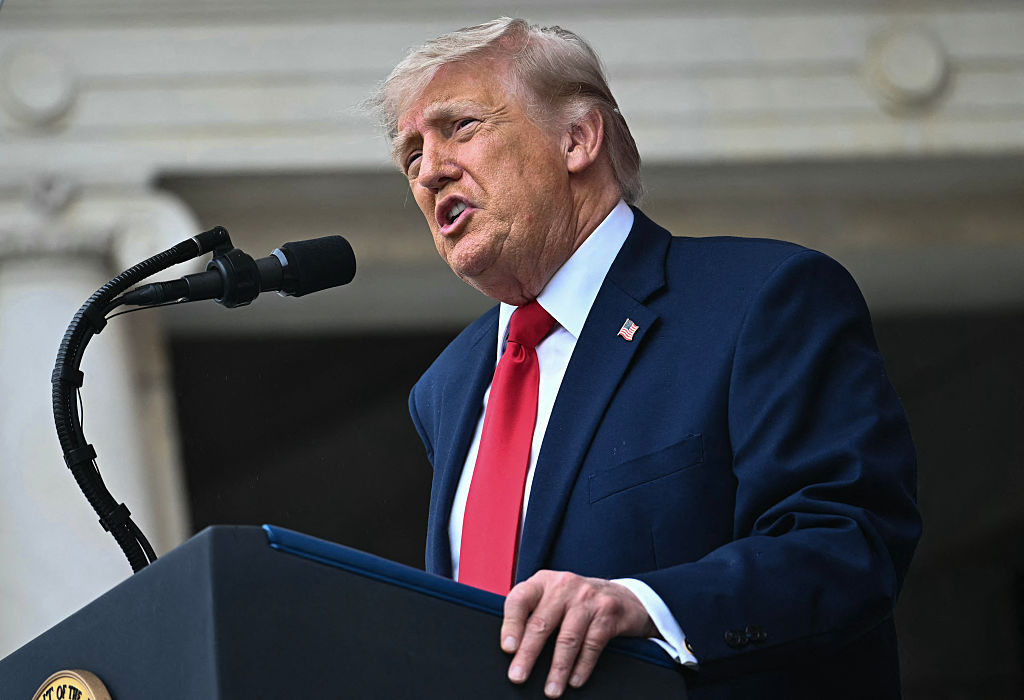
President Donald Trump is suddenly taking losses from his own friends and allies, especially on Capitol Hill.
GOP lawmakers are bucking Trump on his White House ballroom, shelving plans to spend $1 billion to secure the new facility and other areas of the presidential compound.
The “Trump battleships” are steaming into a wave of skepticism at the House Armed Services Committee as lawmakers prepare to mark up the FY2027 defense authorization bill this week. (All puns intended.)
The House may vote this week on a discharge petition for a Ukrainian aid bill that Trump is certain to oppose. Several dozen House Republicans could back the measure anyway.
And after Trump — bogged down in negotiations to end the war with Iran — said Israel had agreed to halt its military assault against Hezbollah in Lebanon, Israeli Prime Minister Benjamin Netanyahu declared he’d continue IDF operations in the southern part of the country. Trump reportedly yelled at Netanyahu over the offensive.
Most prominently, Republicans are also in the process of killing Trump’s $1.8 billion “anti-weaponization” fund, a direct rebuke to the president.
Trump and Hill Republicans are trapped in a dangerous paradox. Trump’s political endorsement is worth more than ever in GOP primaries, yet his legislative agenda and fixation on personal projects are growing more toxic heading into the fall campaign season. As more Republicans move past their primaries, they’re suddenly finding it advantageous to oppose him.
Weaponization-lite. Senate Republicans remain far short of the votes needed to begin floor consideration of their $70 billion reconciliation bill to fund ICE and Border Patrol. GOP leaders will make a decision today about whether it’s possible to pass the bill this week, but that’s looking increasingly unlikely.
At least a dozen GOP senators said Monday that the White House’s attempt to quell the uproar over Trump’s “anti-weaponization” fund wasn’t enough to win their support for advancing the immigration-centric package — something that should unify them.
In a statement, the Justice Department vowed to honor a federal judge’s approval of a temporary restraining order that paused the fund until June 12. But the statement said nothing about how the administration would handle the fund beyond that deadline.
What GOP senators are asking for is pretty basic — assurances that this fund is gone for good.
“The only thing that’s going to solve this problem — to get immigration funded and law enforced — is for the president to do away with the weaponization fund,” Senate Judiciary Committee Chair Chuck Grassley (R-Iowa) told us.
“It’s not enough for me to have the courts push back,” added Sen. John Curtis (R-Utah). “I just want to make sure this thing doesn’t move forward in its current form.”
Senate GOP leaders can’t afford to lose more than three senators on any vote throughout the floor process. Sen. Lisa Murkowski (R-Alaska) suggests she could vote “no” on final passage, regardless of how the “anti-weaponization” fund is addressed. Murkowski remains concerned about funding federal agencies outside the appropriations process.
Still simmering. Senate Republicans made clear that the week-long Memorial Day recess did little to calm their recent tensions with Trump, which have centered on both the weaponization fund and the party’s broader midterm strategy.
Republican senators revolted over Trump’s fund two weeks ago. Senate GOP leaders have since pleaded with the White House to find a solution so they can move forward with reconciliation. Yet it was Speaker Mike Johnson who met with Trump at the White House on Monday to discuss the issue. Hours later, the Department of Justice released its statement.
Senate Majority Leader John Thune, who has made no secret about his frustrations with the president lately, said Monday afternoon that he hadn’t spoken with Trump about the fund since last week. Thune noted that he was in touch with White House officials over the weekend.
Thune approached the DOJ statement delicately but ultimately acknowledged that his rank-and-file GOP senators weren’t yet satisfied. Thune said more public assurances from the administration would be “helpful.”
The South Dakota Republican is practically begging the administration to act on its own to shut down the fund entirely and make clear it won’t be resurrected. Thune believes this remains the best way to un-stick the reconciliation bill and prevent a handful of GOP senators from voting for Democratic amendments during an upcoming vote-a-rama.
But the White House seems unwilling to make this easy for Republicans. Administration officials are leaving GOP leaders guessing about whether they plan to say more about the program later on.
“They need to settle it,” said Sen. James Lankford (R-Okla.), a member of Thune’s leadership team. “They need to say what they actually mean and say, ‘We’re setting this whole thing aside.’”
Thune wants to avoid addressing the issue in the text of the reconciliation bill itself. Doing so would also make it easier for Democrats to cause problems for GOP leaders during the upcoming reconciliation vote-a-rama, which requires only a simple majority for their amendments to pass.
“Confining the bill to its original intent, which was a very narrowly focused reconciliation bill that just addresses the funding for [ICE and CBP], is the clearest path to ultimately getting a bill on the president’s desk,” Thune said.
To that end, Thune also said a $1.5 billion fund for the Justice Department — intended for a wide range of DOJ projects — will be dropped from the bill. That could make it more difficult for Democrats to craft amendments going after Trump’s fund at a simple-majority threshold.
The move also alleviates concerns that the administration would try to divert this money to the weaponization fund. But scrapping the DOJ funding isn’t a solution on its own.
FYSA. Sen. Bernie Sanders (I-Vt.) said he is introducing legislation to have the government take a 50% stake in AI companies.