

November 11, 2025



PRESENTED BY

THE TOP
Schumer’s risk and reckoning
Happy Tuesday morning. And happy Veterans Day to all who have served our country.
The longest government shutdown in U.S. history is on its way to being over, hopefully. The Senate on Monday night passed a Jan. 30 stopgap funding bill to reopen the government, combined with a three-bill minibus. Eight Democrats crossed the aisle to vote with Republicans on the hugely controversial measure.
The House is up next. House members will return Wednesday, after having been gone a mind-blowing 53 days, to vote on the legislation.
The package is expected to pass in the chamber, but it will take some heavy lifting by Speaker Mike Johnson and House GOP leaders to get it there. Much more on this below.
Schumer-centric. As senators struggled to find a way out of the devastating shutdown, missing from the final round of negotiations was one of the most important players: Senate Minority Leader Chuck Schumer.
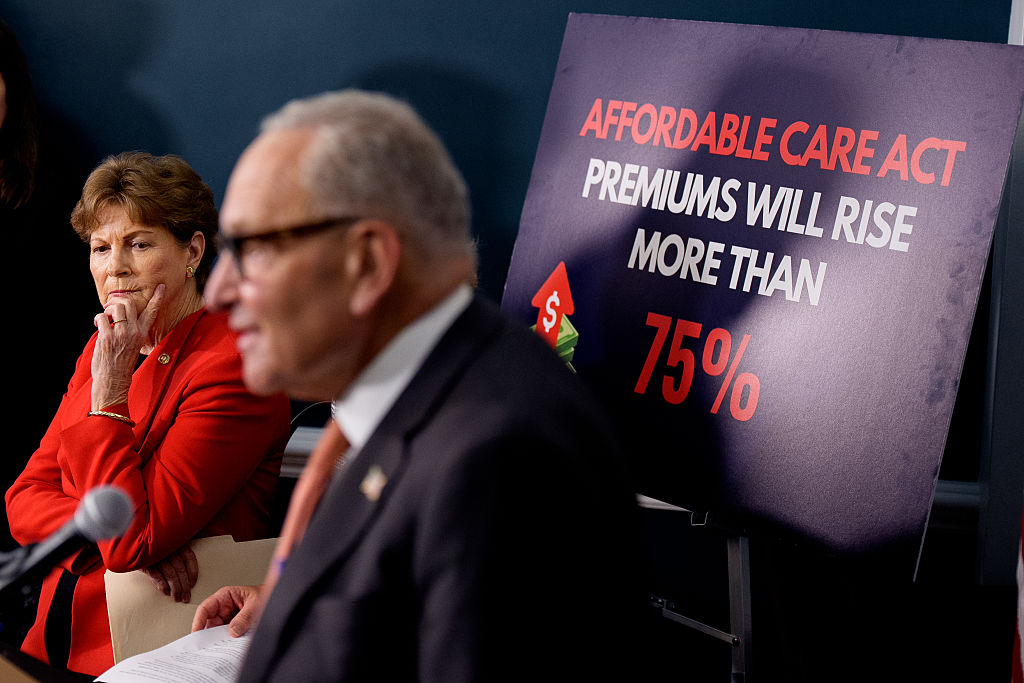
Instead, it was retiring Sen. Jeanne Shaheen (D-N.H.) — among the most vocal Democratic supporters of the expiring Obamacare subsidies — who sat face-to-face with Senate Majority Leader John Thune to button up a key piece of the final deal: A commitment to vote on extending the subsidies.
It was extraordinary for Schumer not to be involved. Yet Thune had declared repeatedly that the path out of the shutdown wouldn’t be through Schumer, but rather rank-and-file Democrats. He turned out to be right.
According to Shaheen, Schumer was kept apprised of the talks with Thune and never tried to dissuade her from engaging with Republicans. Shaheen didn’t have anything negative to say about Schumer, although when pressed, she wouldn’t say whether Schumer backed the Democratic moderates’ engagement with Thune.
“There were a lot of conversations between those of us who were working together and our Republican colleagues, and it seemed like it was important to talk directly,” Shaheen said.
In the end, Schumer voted against the bipartisan deal to end the shutdown, joining with the majority of his caucus in lashing out at President Donald Trump and Republicans.
But it’s Schumer who’s taking most of the heat from progressives. His response was to tout the perceived political victory Democrats scored.
“The American people have now awoken to Trump’s health care crisis,” Schumer said on the floor before the final vote.
More Schumer:
The backlash. Despite the uproar from the left, Schumer’s job is safe.
Schumer was going to get slammed here no matter what the outcome was, something we warned you about. Schumer took a big risk by advocating for a shutdown. He and House Minority Leader Hakeem Jeffries gambled that they could pull Trump into the fight to counter Thune and Johnson. When Trump didn’t bite, the standoff became a question of who would blink first.
In some ways, Democrats’ big electoral wins a week ago made the situation even tougher for Schumer. Trump complained the shutdown was “worse for us than them.” Schumer wavered, allowing the fight to drag into the weekend.
Progressive groups and the Democratic base were convinced that if Schumer just stayed the course, Republicans would fold — despite the growing national problems stemming from the shutdown. This was a major misread.
Yet Schumer also wouldn’t greenlight a deal to end the impasse. Chastened from the March CR debacle, Schumer embraced the shutdown and continuously rejected any deals with Republicans.
However, Schumer’s own political future became tied to the shutdown, a treacherous spot to be in. Whether to continue supporting Schumer as leader has now become an issue in Senate Democratic primaries. Party insiders wonder whether his unpopularity on the left will impact fundraising, particularly at Senate Majority PAC, the leadership super PAC.
Schumer is known to religiously track polling data and let that guide his decision-making. Polls consistently showed Republicans getting the blame for the shutdown. That approach won Schumer some goodwill from inside his caucus.
But being the leader means you have to take arrows for everyone else. Just look at former Senate GOP Leader Mitch McConnell (R-Ky.), who consistently took heat from the right when he and a small group of Republicans would vote with Democrats to pass funding bills. Schumer did that in March, was relentlessly hammered for it, then shifted tactics.
Irate at the perceived fold, progressives blame Schumer for failing to rein in moderates like Shaheen. Sens. Bernie Sanders (I-Vt.) and Elizabeth Warren (D-Mass.) — whom Schumer included in numerous meetings and strategy sessions — aren’t offering support. Others tiptoe around the question.
“You cannot defend this democracy effectively if you are not united as an opposition party, and we are repeatedly showing that we are not united,” Sen. Chris Murphy (D-Conn.) said. “Sen. Schumer didn’t want this to be the outcome, and he pressed hard for it not to end. He didn’t succeed.”
There’s no real appetite to oust Schumer, though. Nor is there any interest from another Democrat to challenge him, according to interviews with more than a dozen Democratic senators.
“He had a tough job,” Sen. Richard Blumenthal (D-Conn.) said. “Republicans forced an impossible, false choice between affordable health care and reopening the government.”
“The criticisms — I mean, I understand them,” added Sen. Tim Kaine (D-Va.), who broke with Schumer to back the funding deal. “But I think he led us in about the best way he could given the fact that we’re from different states and have different perspectives on this stuff.”
— Andrew Desiderio, John Bresnahan and Max Cohen
Join us on Thursday, Dec. 4 at 9 a.m. ET for a conversation with Senate Appropriations Committee Chair Susan Collins (R-Maine). Punchbowl News Senior Congressional Reporter Andrew Desiderio will sit down with Collins to discuss the news of the day and the future of Alzheimer’s diagnosis and treatment. Afterward, Joanne Pike, president and CEO of the Alzheimer’s Association, will join Anna Palmer, founder and CEO of Punchbowl News, for a fireside chat. RSVP now!


THE HOUSE
What’s next for the CR in the House
The battle over government funding now shifts to the House.
After a near-record absence, Speaker Mike Johnson will reconvene the House on Wednesday to reopen the government. But the chamber’s return won’t be without challenges.
We say this during every legislative crisis: President Donald Trump is in favor of this package, so the safe bet is that House Republicans aren’t going to abandon him.
Yet Johnson has only a two-vote margin and will need all the help he can get. House Republican leadership is watching GOP Reps. Marjorie Taylor Greene (Ga.), Thomas Massie (Ky.), Victoria Spartz (Ind.) and Warren Davidson (Ohio) as possible no votes. Massie is almost guaranteed to vote no.
House Democratic leadership — led by Minority Leader Hakeem Jeffries — is whipping against the bill because it doesn’t address the expiring Obamacare premium tax credits.
Still, Democratic aides believe Reps. Henry Cuellar (D-Texas), Jared Golden (D-Maine), Marie Gluesenkamp Perez (D-Wash.) and Vicente Gonzalez (D-Texas) could be in play to vote for the bill. Rep. Susie Lee (D-Nev.) also sounded like she could vote yes on a caucus call Monday. Both Nevada senators — Democrats Jacky Rosen and Catherine Cortez Masto — voted for the spending package.
The timeline. The House Rules Committee could meet as soon as this evening to set the guidelines for floor debate of the Senate-passed measure. And that Rules markup could be a long slog.
The House Republican leadership is aiming for a Wednesday vote on the funding package.
The political dynamics. Johnson has the most at stake. But the speaker can make the argument that this Senate agreement has significant victories for the GOP.
Republicans didn’t give up an inch in this entire shutdown. Johnson hasn’t committed to a vote on the Obamacare tax credits — unlike Senate Majority Leader John Thune. The speaker has been vocally opposed to the credits for nearly two months.
Johnson has said he would rather try to build consensus for a GOP health care plan. Johnson is finally getting the appropriations process restarted, which has been a key goal since he took the speaker’s gavel in 2023. The House Freedom Caucus is supporting the spending package, which should help the speaker.
Johnson is going to face major tests during the next few months. In addition to the fallout over keeping the House out so long, Johnson will have to work with the Senate to come up with compromise FY2026 spending bills. Senate spending levels are much higher than what House Republicans want. And Johnson has said he wants to cobble together a health care plan.
With cost-of-living and affordability concerns driving politics for the foreseeable future, most smart House Republicans understand they can’t simply point to proposals they’ve supported that have never become law. They’ll need to pass something and look for Democratic support.
Once again, Johnson may be nudged along by a discharge petition. Jeffries said on a private party call Monday that Democrats may file and support a discharge petition to force a vote on renewing the Obamacare subsidies. This is a long shot given that these subsidies expire on Dec. 31, but it’s worth keeping an eye on because that may force Johnson’s hand.
Now let’s talk about Jeffries. Jeffries has been in sync with the Democratic base more than any other party leader. Remember: the House minority leader opposed Senate Minority Leader Chuck Schumer’s decision to keep the government open back in March. Jeffries has had the luxury to stand pat over the last few weeks while Senate Democrats took the lead in the shutdown fight.
– Jake Sherman, Laura Weiss and Ally Mutnick

THE SENATE
Britt flexes her dealmaking muscles
Just minutes after announcing his support for a bipartisan deal to end the government shutdown, Sen. Tim Kaine (D-Va.) beelined toward Sen. Katie Britt (R-Ala.) on the Senate floor to shake her hand.
Britt had spent the last few days quietly working to secure White House support for Kaine’s push to reverse the administration’s mass layoffs of federal workers during the shutdown. The White House got on board, even endorsing back pay for federal workers.
But Kaine, who represents 320,000 federal employees, needed more than that: A ban on future layoffs, known as reductions-in-force (RIFs). The White House initially rejected this but eventually agreed. The reason why, Kaine said, was Britt.
“I said, ‘Thank you for helping convince the White House on the RIFs,’” Kaine said of his handshake with Britt. “They really did not want to do it… And I said, ‘I’m a no if you don’t do that.’”
“When I explained it to her, she said that’s a reasonable ask. But the White House didn’t want to do it,” Kaine added. “And she was the go-between on that.”
The bipartisan deal to end the longest shutdown in history would’ve collapsed without Kaine’s support, and Republicans credited Britt with helping get that.
Britt’s maneuver was just the latest example of the first-term senator flexing her dealmaking prowess and MAGA bona fides by leveraging her close ties with the White House, including Vice President JD Vance, to resolve cross-aisle impasses.
In an interview, Britt acknowledged that Kaine is an outspoken opponent of President Donald Trump, but argued he was just fighting on behalf of his constituents. Britt worked the phones well past midnight for several days leading up to Sunday’s successful procedural vote, keeping in close touch with GOP leaders.
“The question was put on the table — how can they be guaranteed backpay, how can they be guaranteed… getting their job back, making sure they can maintain it,” Britt said. “Those were all conversations that drew Sen. Kaine to the table as he fought for the people he serves.”
Bright future? At a GOP Conference meeting on Sunday, Senate Majority Leader John Thune called Britt a “rock star” for helping resolve one of the thorniest issues in the funding talks.
First elected in 2022, Britt keeps her head down and doesn’t seek out media attention. Britt’s colleagues have taken notice of her eagerness to help address major policy and political stalemates — both inside the Senate GOP Conference as well as with Democrats and the White House.
Britt, 43, once served as chief of staff to former Senate Appropriations Committee Chair Richard Shelby (R-Ala.), giving her a deep understanding of how the sausage is made. Britt was even given a seat on the panel as a freshman lawmaker, which is rare.
But since Britt arrived in the Senate, the Appropriations Committee has become increasingly irrelevant. The Trump administration has sought to undermine Congress’ power of the purse, and both parties have failed in recent years to prioritize appropriations bills for floor time.
Britt viewed the shutdown deadlock as a chance to get the appropriations process back on track. A few weeks into the shutdown, Britt approached Senate Minority Leader Chuck Schumer about reviving efforts to pass a conferenced version of the first three-bill minibus.
That measure was eventually added to the funding package that reopened the government. Britt pitched Democrats on using it as a way to wield one of their few levers of power in a GOP-controlled Washington.
“We need opportunities to work together and to build trust, and I felt like this was a good way to do that,” Britt said.
— Andrew Desiderio
PRESENTED BY THE BOEING COMPANY

We’re driving advancements in technology to ensure the U.S. remains a leader in aerospace innovation.

The Vault: Crypto gets a good(ish) Senate headline
The Senate Agriculture Committee made a splash on Monday night, releasing a draft of crypto market structure legislation with bipartisan backing. That’s no small feat, and one the Senate Banking Committee has been unable to accomplish so far this year.
There’s a caveat, though. The discussion draft, led by Chair John Boozman (R-Ark.) and Sen. Cory Booker (D-N.J.), is very much a work in progress. Large chunks of the legislation’s key components are marked as “unresolved,” meaning they have not been fully agreed to between the two parties.
But crypto advocates and allies are thrilled about having bipartisan text in hand. “I hope it spurs us on,” Banking Committee Republican Sen. Cynthia Lummis (Wyo.) told reporters Monday night.
{if (profile.vars.Memberful_punchbowlnews_Plan_Premium_Policy_The_Vault_I_121828 == true || profile.vars.Memberful_punchbowlnews_Plan_Premium_Policy_The_Vault_I_103061 == true || profile.vars.Memberful_punchbowlnews_Plan_Premium_Policy_The_Vault_II_121827 == true || profile.vars.Memberful_punchbowlnews_Plan_Premium_Policy_The_Vault_II_103417 == true || profile.vars.Memberful_punchbowlnews_Plan_Premium_Policy_The_Vault_III_121826 == true || profile.vars.Memberful_punchbowlnews_Plan_Premium_Policy_The_Vault_III_103418 == true || profile.vars.Memberful_punchbowlnews_Plan_Premium_Policy_The_Vault_14_Day_Trial_121832 == true || profile.vars.Memberful_punchbowlnews_Plan_Premium_Policy_The_Vault_14_Day_Trial_103643 == true || profile.vars.Memberful_punchbowlnews_Plan_Punchbowl_News_Premium_Portal_The_Vault_Tech_121727 == true || profile.vars.Memberful_punchbowlnews_Plan_Punchbowl_News_Premium_Portal_The_Vault_Tech_121821 == true || profile.vars.Memberful_punchbowlnews_Plan_Punchbowl_News_Premium_Portal_Premium_Policy_The_Vault_121726 == true || profile.vars.Memberful_punchbowlnews_Plan_Punchbowl_News_Premium_Portal_Premium_Policy_The_Vault_121823 == true || profile.vars.Memberful_punchbowlnews_Plan_Punchbowl_News_Vault_Tech_126214 == true || profile.vars.Memberful_punchbowlnews_Plan_Punchbowl_News_Vault_Tech_126263 == true || profile.vars.Memberful_punchbowlnews_Plan_Punchbowl_News_Premium_Portal_The_Vault_Tech_Defense_138992 == true || profile.vars.Memberful_punchbowlnews_Plan_Punchbowl_News_Vault_Tech_Defense_136971 == true || profile.vars.Memberful_punchbowlnews_Plan_Punchbowl_News_Vault_Tech_Defense_138990 == true || profile.vars.Memberful_punchbowlnews_Plan_Punchbowl_News_Defense_Vault_136973 == true || profile.vars.Memberful_punchbowlnews_Plan_Punchbowl_News_Defense_Vault_138989 == true || profile.vars.Memberful_punchbowlnews_All_Access_Pass == true)}
The draft. Spanning 155 pages, the bill you can read here only covers roughly half of the overall market structure effort. The Agriculture Committee is responsible for the Commodity Futures Trading Commission, which will be empowered to regulate and oversee a larger chunk of the financial system if this legislation is eventually passed.
There are sections here that have bipartisan agreement between Boozman and Booker. That includes much of the language giving the CFTC “spot market” regulatory authority, which are financial markets where goods and commodities are traded immediately, as opposed to futures markets.
But other key sections are simply left blank. That includes Sec. 208 of the bill, on decentralized finance, which simply reads: “Seeking further feedback.” DeFi rules have been a major sticking point on the Senate Banking Committee as well.
There are interesting nuggets of bill text that are bracketed off as “unresolved.” That includes “Sense of Congress” language that would require the CFTC to be “fully constituted” with input from the “ranking minority member” of the Agriculture panel before market structure legislation is actually implemented. We told you last week that Booker was pushing for Democratic commissioners at the CFTC.
Meanwhile, at the FDIC. Sen. John Kennedy (R-La.) said he will release a statement “in the first part of the week” about Federal Deposit Insurance Corp. acting Chair Travis Hill. Hill is the Trump administration’s nominee to lead the FDIC full-time, but Kennedy has held up his nomination over concerns about the agency’s toxic workplace culture.
In a brief interview Monday night, Kennedy said he’d read a report provided by the FDIC last week detailing how the agency had responded to reports of rampant sexual harassment and misconduct first revealed in 2023. Kennedy said he’d release that report to the public alongside his statement.
– Brendan Pedersen
{else}

{/if}
THE CAMPAIGN
News: Michigan Families for Fair Care is airing a $385,000 ad buy attacking freshman Rep. Tom Barrett (R-Mich.) for supporting cuts to veterans’ health care.
The ad features an Iraq War veteran and Lansing, Mich., resident who relies on the Department of Veterans Affairs for his health care.
The veteran, Steve, said Barrett voting to cut veterans’ care while supporting “tax breaks for billionaires” is a “spit in our face.”
— Max Cohen


Presented by Comcast

Live sports streaming has driven many of the top 10 Internet traffic events in Comcast network history in just the past two years alone. Comcast is innovating its network so fans can stream the biggest moments in sports with the most reliable connection and ultra-low latency.

Crucial Capitol Hill news AM, Midday, and PM—5 times a week
Join a community of some of the most powerful people in Washington and beyond. Exclusive newsmaker events, parties, in-person and virtual briefings and more.
Subscribe to Premium
The Canvass Year-End Report
And what senior aides and downtown figures believe will happen in 2023.
Check it outEvery single issue of Punchbowl News published, all in one place
Visit the archive
Presented by Comcast
Live sports streaming has driven many of the top 10 Internet traffic events in Comcast network history in just the past two years alone. Comcast is innovating its network so fans can stream the biggest moments in sports with the most reliable connection and ultra-low latency.