


April 1, 2026



PRESENTED BY

THE TOP
Could Dems blow it in Virginia?
Happy April Fools’ Day. Passover begins tonight.
In 20 days, Virginia voters will decide if their legislature is allowed to gerrymander the state’s congressional map to turn 10 of the 11 House seats blue for the midterms.
Yet despite a high-profile push that includes former President Barack Obama, Democrats are growing increasingly skittish about the referendum.
A nonprofit allied with House Democratic leadership upped its investment to $20 million this week. Private polling indicates a tight race within or not too far outside the margin of error, according to sources briefed on the results.
Initial early-voting results also raised fresh concerns that Democratic voters weren’t turning out. That disparity is now shrinking. But there are still real concerns about Black voters, particularly because Republican mailers have featured Obama’s past comments disparaging gerrymandering to suggest he doesn’t support the referendum. In fact, Obama has made TV ads in favor of it.
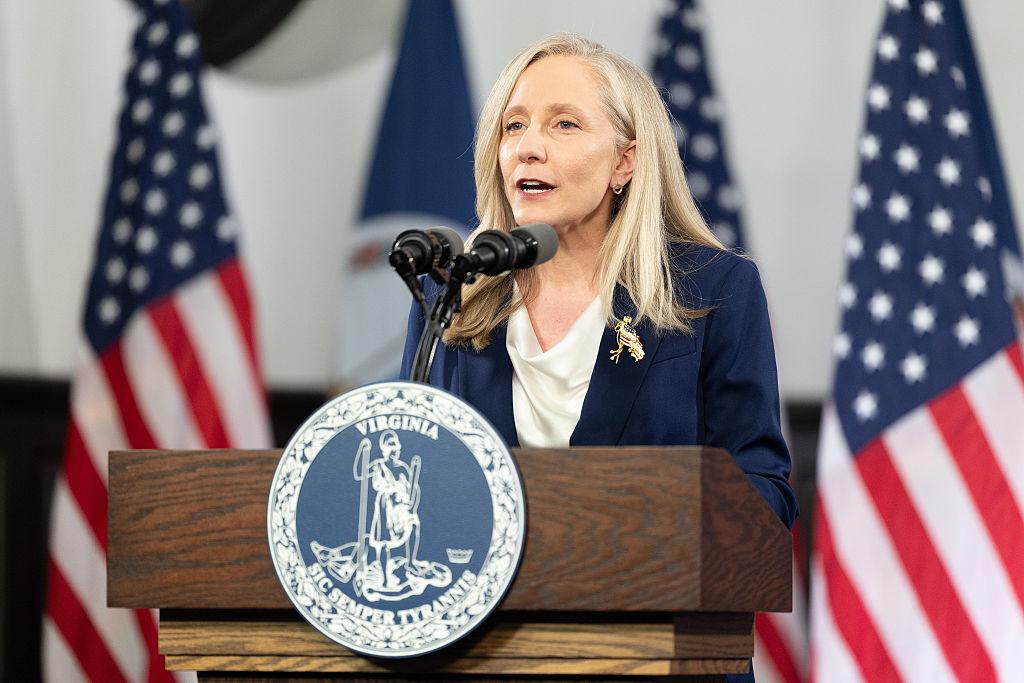
Democratic Gov. Abigail Spanberger won the state by 15 points in 2025, but overall, the Old Dominion is far more purple than blue.
“There’s no equivalence between her win in November and this referendum,” Rep. Don Beyer (D-Va.) said of Spanberger. “We still have three weeks to go. To think, ‘It’s in the bag,’ would be a fatal mistake. We have to close very strong.”
Plenty of Democrats believe they’ll still win the redistricting referendum, yet the margin is too close for comfort. There’s also a massive financial gap in their favor.
Virginia Democrats’ pro-redistricting campaign has reported raising $38.3 million compared to Republicans’ $8 million. Some Republicans have privately suggested this signals that Virginia GOP leaders know they’ve lost the referendum and are saving their money for later in the cycle.
Dems’ challenge. The Democrats urging a yes vote on this referendum are the same ones who pushed voters to pass a bipartisan redistricting commission in 2020.
But that was a lifetime ago politically, particularly before President Donald Trump incited a mid-decade national redistricting battle. Virginia is a pivotal part of the Democrats’ response to the GOP effort. The current Virginia delegation is split 6D-5R. The new map would be an aggressive gerrymander of 10D-1R.
The Democratic message is to relentlessly stress that this referendum would only temporarily pause the redistricting commission, and that it’s only in response to GOP gerrymandering in Texas, North Carolina and other states, with Florida still upcoming. Democrats made their own big redistricting push in California and now Virginia.
But here’s the problem: Democrats could be victims of their own success in the redistricting wars. When California voters paused their redistricting commission last year, the GOP gerrymander of Texas was top of mind. Then Republicans lost their Indiana redistricting gambit, and their Florida play won’t begin until April 20, just before the Virginia referendum vote.
Spanberger also hasn’t been a champion of redistricting in the same way California Gov. Gavin Newsom shepherded a new map through a referendum in his state. (That’s led some Democrats to start pointing fingers at her.)
“Virginia’s not California,” Rep. Jennifer McClellan (D-Va.) said. “It’s apples to oranges.”
GOP strategy. Republicans know they have to keep the Virginian referendum fight from being nationalized or becoming a referendum on Trump.
A path to victory looks like this: Republicans need to run up the margins in the Hampton Roads region and blow Democrats out of the water in the rural areas. Former GOP Gov. Glenn Youngkin will campaign next week in the rural southwestern part of the state.
Republicans are aware they won’t win Northern Virginia and Richmond, but GOP insiders hope to avoid a huge loss there.
The Republican plan: use Democrats’ own words against them. Gerrymandering isn’t popular and that’s essentially what this referendum is asking voters to endorse.
Virginians for Fair Maps, the GOP group opposing the referendum, reported receiving a $5 million donation Tuesday from an allied nonprofit, bringing its total reported contributions to $8 million.
“The No side is unified and we are getting our message out about the illegal, disenfranchising maps put forth by the Democrats,” said Mike Young, campaign manager for Virginians for Fair Maps.
But another group has received more attention. Justice for Democracy sent mailers featuring a photo of Obama next to the text: “Protect Minority Representation. Vote NO on Gerrymandering!” Obama has endorsed the Yes campaign. A second mailer from an allied group compares the Yes campaign to “Jim Crow”’ and includes photos from the Civil Rights movement.
McClellan said she had heard overwhelmingly from Black voters who received those mailers. Democrats will hold news conferences and go on Black radio stations “to respond to that misinformation,” McClellan added.
“The mailings from President Obama, you can tell those are effective, because the other side is using his image to try to convince people to vote no.” Rep. James Walkinshaw (D-Va.) said. “And I think we’ll see his engagement ramp up between now and April 21. People will hear more from him.”
Trump on Iran: Trump will address the nation on the Iran war at 9 p.m. tonight, White House Press Secretary Karoline Leavitt announced.
– Ally Mutnick and John Bresnahan
NEW EVENT: Join us on Tuesday, April 21, at 8:30 a.m. ET for a conversation with Rep. Julie Fedorchak (R-N.D.). Punchbowl News Founder and CEO Anna Palmer will sit down with Fedorchak to discuss the news of the day and American leadership in wireless, spectrum and AI. Afterward, Ajit Pai, President and CEO of CTIA, will join Anna for a fireside chat. RSVP now!


THE MIDTERMS
Trump mail-in ballot EO will face legal challenges
President Donald Trump’s controversial new executive order on mail-in voting has set off a furor among Democrats and voting rights groups, who’re bashing it as an unconstitutional power grab. They’re also threatening immediate legal action.
Privately, even some Republicans were stunned by the Trump EO, which mandates the creation of a “State Citizenship List” by the Department of Homeland Security and requires “USPS to transmit ballots only to individuals enrolled on a State-specific Mail-in and Absentee Participation List.” Here’s an explainer from the White House on the order.
Trump would also require proof of citizenship to register to vote in federal elections, something mandated by the SAVE America Act. That legislation has passed the House but is part of a bitter partisan fight in the Senate that’s left DHS shut down for a record 46 days.
Democrats blasted the Trump order and promised legal challenges. “See you in court. You will lose,” tweeted Senate Minority Leader Chuck Schumer.
“This executive order is a blatant, unconstitutional abuse of power,” said Sen. Alex Padilla (Calif.), top Democrat on the Senate Rules and Administration Committee and a former California secretary of state. “The President and the Department of Homeland Security have no authority to commandeer federal elections or direct the independent Postal Service to undermine mail and absentee voting that nearly 50 million Americans relied on in 2024.”
“Donald Trump fears the American people and is willing to violate the Constitution to stop them from voting. His Executive Order is illegal, dangerous and subversive. It will not stand,” added Rep. Joe Morelle (N.Y.), top Democrat on the House Administration Committee.
Trump vs. mail-in voting. Trump has long bashed mail-in voting, despite its growing popularity. Trump calls it “cheating” and “a hoax,” while promising to end it for the 2026 midterms. This comes even though Trump uses mail-in ballots himself, including in a recent Florida election.
Under federal law, states administer federal elections, including voting by mail requirements and restrictions. Trump’s order would dramatically alter that relationship. States would still administer federal elections, but federal agencies would tell them beforehand who can vote and then play a role in certifying the use of mail-in ballots or absentee ballots sent by mail.
The Department of Homeland Security will create a “State Citizenship List” of those citizens eligible to vote in federal elections. The list will be based upon data from the Social Security Administration, U.S. Citizenship and Immigration Services and “other relevant Federal databases.” An eligible voter list will be sent to each state “no fewer than 60 days before each regularly scheduled Federal election” or as required during special elections.
The USPS will create special mail-in or absentee ballot envelopes, and voters will have to be on an approved list to use the mail to send in these ballots.
States will only be allowed to send mail-in voter forms to registered voters who have proven they’re U.S. citizens. This issue is at the heart of the SAVE America Act fight in Congress. States that don’t comply will lose federal election-related funds.
Republicans say they’re ok with the Trump order, although many individual GOP lawmakers have spoken publicly in favor of voting by mail.
“The contrast is crystal clear: Republicans are for protecting election integrity, ensuring only eligible citizens vote, and restoring confidence in our elections,” said Will Kiley, the NRCC communications director. “While Democrats fight common-sense safeguards aimed at making it easy to vote but hard to cheat, House Republicans stand for the rule of law.”
— John Bresnahan

THE CAMPAIGN
How Suozzi is prepping for reelection in Trump country
Rep. Tom Suozzi (D-N.Y.) knows that Democrats have a branding problem. But the centrist, who represents a Long Island-area seat that President Donald Trump won in 2024, is encouraged by his party’s messaging as the midterms approach.
During our recent interview, the 63-year-old Suozzi said last fall’s government shutdown showdown over the ACA tax credits was the “perfect fixer” for streamlining Democrats’ messaging problems.
“We talked about affordability — the number one issue in America — of health care, which is number five. And it’s an issue we happen to have credibility on,” Suozzi said. “The Democrats are doing better than they have been doing.”
Suozzi is no stranger to high-profile, toss-up elections. After ditching his House seat for an unsuccessful gubernatorial run, Suozzi won a heavily contested special election in February 2024 following former Rep. George Santos’ (R-N.Y.) expulsion. In that race, Suozzi leaned in on immigration. Suozzi now thinks 2026 will be about the high cost of living.
We’ll note that in the months since the fall shutdown, Democratic affordability messaging has been muddled by the ongoing DHS shutdown and ICE controversies that have captivated the country.
Reelection watch. Republicans didn’t spend heavily in November 2024 to knock off Suozzi, and the Democratic incumbent beat GOP candidate Michael LiPetri by four points. But Trump’s win in the district by 19,000 votes has given Republicans hope they could unseat Suozzi this year.
Last month, NRCC Chair Richard Hudson singled out Suozzi’s seat as a top GOP target. Suozzi said he’s in “for a real race,” exacerbated by the heat he takes from his left and right flanks.
“I have to always deal with the fact that some of my far-left is not happy with me and then the Republicans are going to say bad stuff about me just because I’m a Democrat,” Suozzi said. “When you’re in the middle of the road, you know what happens? You get run over.”
Progressive backlash. Suozzi’s issues with the left were on full display when he voted to fund DHS in January. After facing a backlash back home, Suozzi apologized for “failing to recognize that this vote was viewed as a referendum on the illegal and moral behavior of ICE.”
“It was a very, very bad time. I got a lot of very negative responses to it,” Suozzi reflected. But after meeting with local activists who he’s long engaged with since his time as mayor of Glen Cove, N.Y., Suozzi insisted, “I’m fine.”
“The groups are with me locally. They realize how important my seat is. I have people against me on the left, but I’m not getting organized efforts against me by the left,” Suozzi said.
Suozzi still expects Republicans to paint him as too left-wing, despite his moderate brand.
“They’re going to put Zohran Mamdani on every piece of literature with me,” Suozzi said, noting he’s long opposed the New York City mayor. “In my district, they don’t like Zohran Mamdani.”
Another wrinkle in New York’s 3rd District? The GOP gubernatorial candidate is Nassau County Executive Bruce Blakeman, who represents parts of Suozzi’s district. Republicans hope Blakeman’s coattails will boost downballot races in the New York City suburbs, much like former Rep. Lee Zeldin (R-N.Y.) in 2022.
— Max Cohen
PRESENTED BY META


K Street believes in federal AI regulation
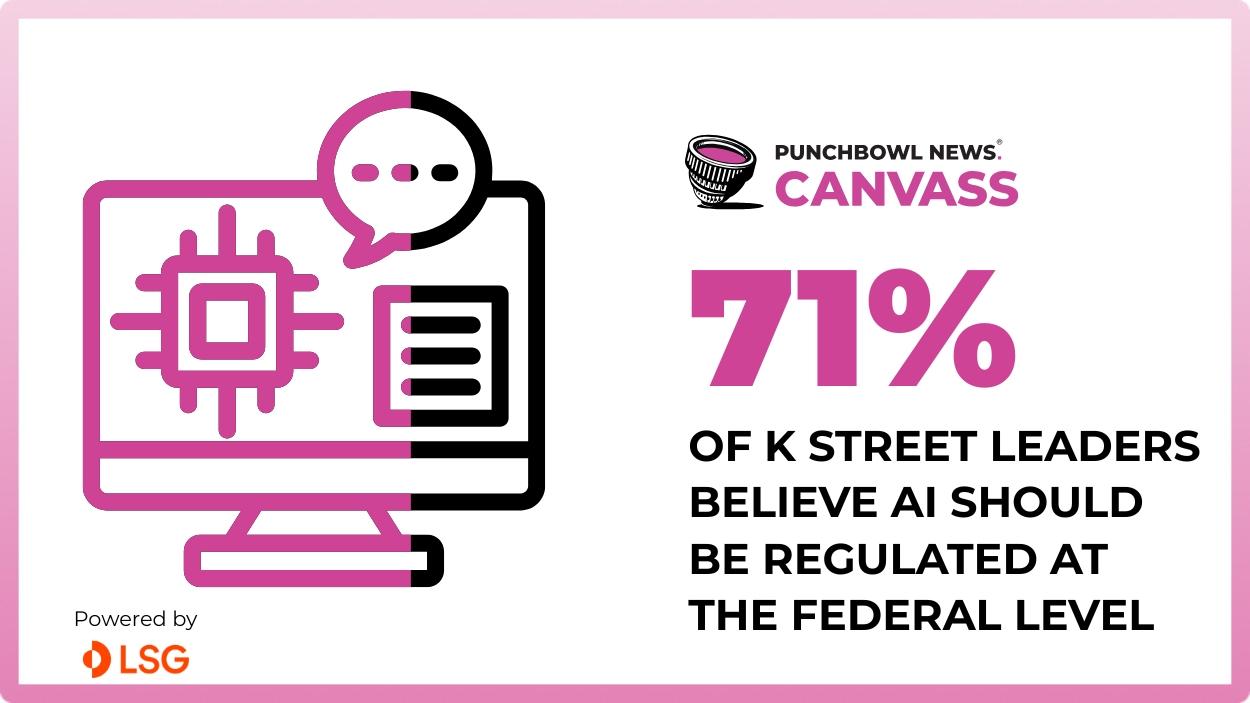
A majority of K Street leaders say artificial intelligence regulation should primarily be handled at the federal level by Congress, according to our latest Canvass results.
More Republicans (79%) than Democrats (60%) shared the sentiment that AI should be federally regulated.
President Donald Trump has sought to restrict state laws related to AI, while instead setting a national standard for the technology.
The White House released a proposal in March for federal regulation of AI that would overrule most state policymaking. The proposal also seeks to protect young people, creators, political speech and local governments that want to make their own decisions on data centers.
Democrats say the proposal doesn’t do enough for workers at risk of losing their jobs as AI advances while letting the industry off the hook. Top Republicans acknowledged it will be difficult for Congress to enact comprehensive AI regulation this year.
Republicans generally have supported Trump’s desire to focus on a national framework. On Capitol Hill, Democrats want states to have a robust consumer-protection role alongside the federal government. But on K Street, the majority of Democrats still focused on uniform rules.
The Canvass K Street was conducted March 2-20 in partnership with independent public affairs firm, LSG.
Want to take part in The Canvass? Our survey provides anonymous monthly insights from top Capitol Hill staffers and K Street leaders on key issues facing Washington.
Don’t miss out on your chance to weigh in! Sign up here if you work on K Street. Click here to sign up if you’re a senior congressional staffer.
— Shania Shelton
AND THERE’S MORE
Ballard Partners has signed Northrop Grumman. Ballard will lobby on “[a]dvocacy regarding matters relating to the defense industrial base and federal government procurement.”
Endorsement corner. Former Rep. Cori Bush (D-Mo.) received an endorsement from the Peace, Accountability, and Leadership PAC. The group is allied with the Institute for Middle East Understanding and was formed as a counter to pro-Israel groups.
AIPAC’s super PAC spent millions of dollars last cycle to oust Bush, who is now making a comeback bid.
EMILYs List is backing Lauren Babb Tomlinson in California’s 6th District and Pia Dandiya in Florida’s 21st District.
– Jake Sherman and Ally Mutnick
PRESENTED BY META


Presented by AstraZeneca

The 340B program is supposed to help vulnerable patients—but without strong safeguards, it’s siphoning away funds that could be used for free and charitable medicine. The 340B Rebate Model Pilot improves program integrity, preventing duplicate discounts and strengthening accountability. Urge HHS to implement the pilot today. Learn why it matters.

Crucial Capitol Hill news AM, Midday, and PM—5 times a week
Join a community of some of the most powerful people in Washington and beyond. Exclusive newsmaker events, parties, in-person and virtual briefings and more.
Subscribe to Premium
Special Projects
Explore our deep dives into the issues that matter the most today and will shape tomorrow's future, with expert reporting that goes beyond the headlines and into the heart of the Capitol.
Check it outEvery single issue of Punchbowl News published, all in one place
Visit the archive
Presented by AstraZeneca
The 340B program lacks transparency—making it hard to tell if it’s actually helping vulnerable patients. HHS can fix the problem by implementing the 340B Rebate Model Pilot, ensuring the program is transparent, compliant, and accountable. Learn more.