
PRESENTED BY

THE TOP
Welcome to Punchbowl News Defense
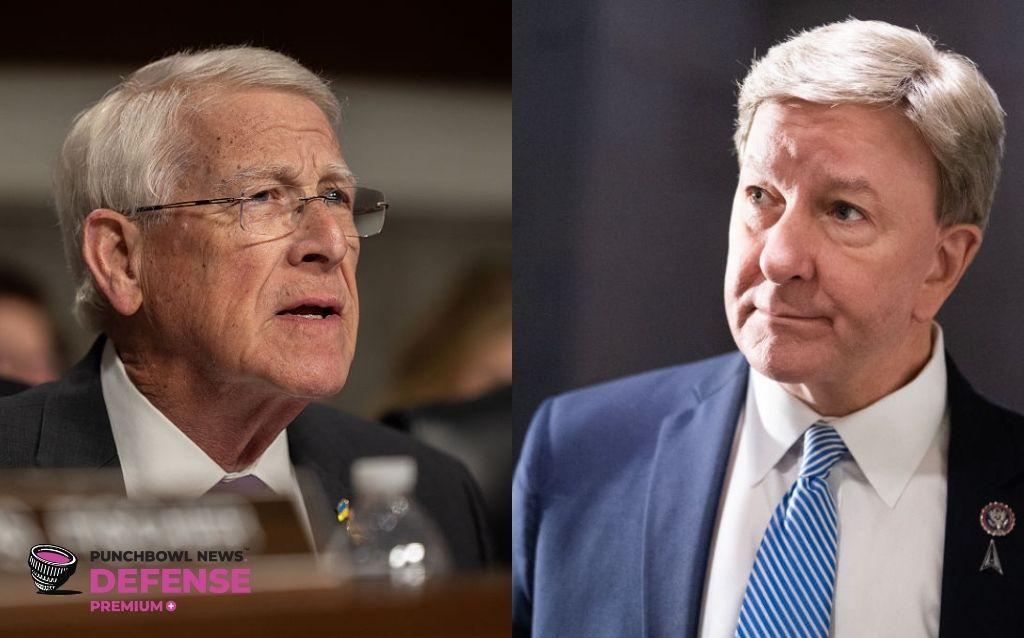
Happy Tuesday morning.
Congress is battling a series of simultaneous challenges on the homefront and abroad as it relates to defense and national security.
Debating how best to direct approximately $1 trillion in defense spending at a time of deep concern over increasing government debt. Flexing atrophying bipartisan oversight muscles. Expressing tepid GOP support for a controversial Pentagon leader. Trying to disrupt the decades-old ways of doing business.
It’s a lot. So, that’s where we come in. Welcome to Punchbowl News’ latest Premium+ offering: Defense.
We’ll be here daily to break it all down for you.
Why now, you may ask? The challenges here and abroad are acute, with new ones popping up almost every single day. There are deep divisions within the parties about how to handle war powers, defense spending and projecting power abroad. These are only going to become more pronounced in the months ahead.
Here’s what you can expect from our first edition:
— A deeply reported look at the defense landscape and how key lawmakers are thinking through this moment of significant tension and change.
— An in-depth analysis of the power shift afoot among leading defense policy voices on Capitol Hill, particularly in the Republican ranks.
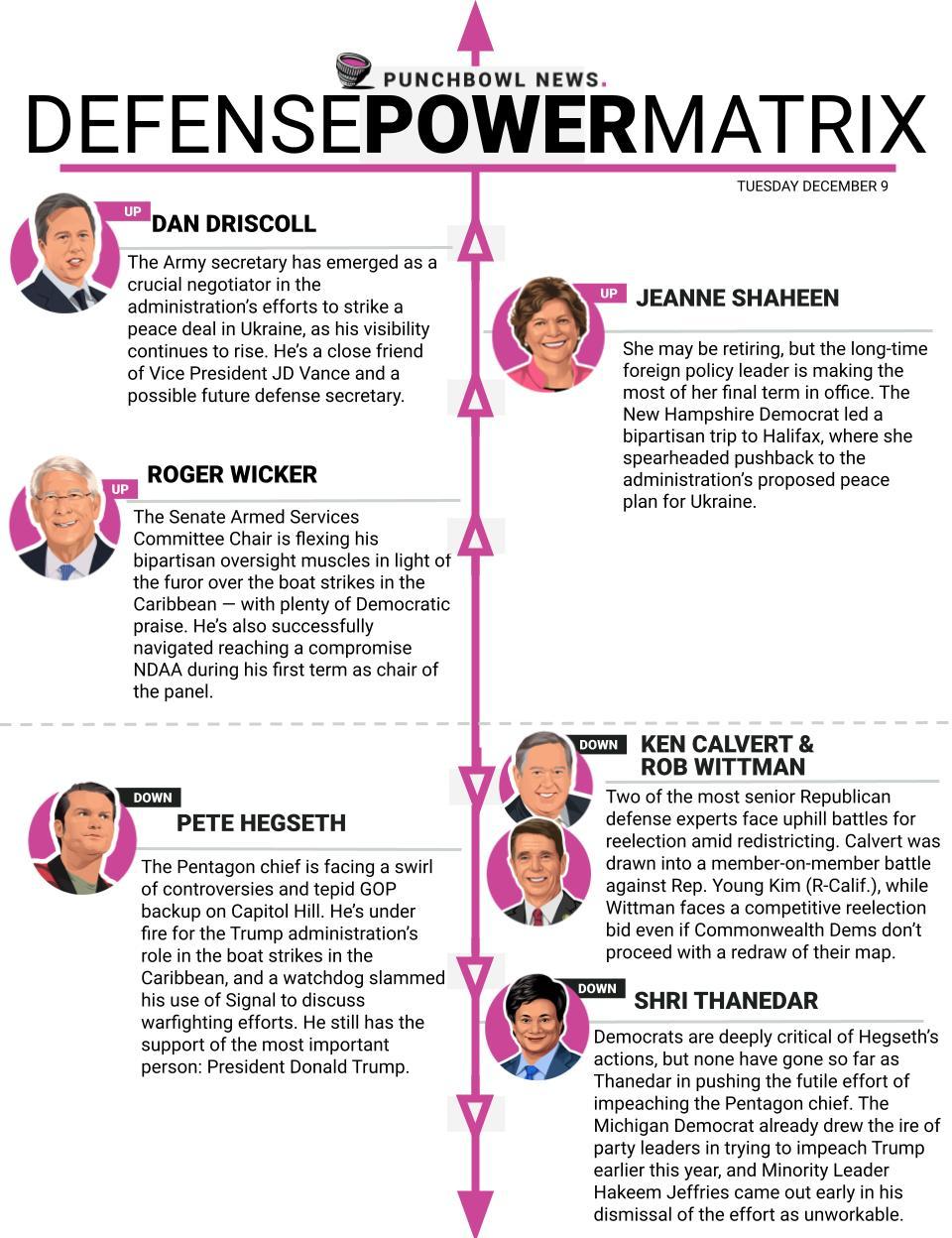
— The quintessential Punchbowl News Power Matrix for who’s up and who’s down in the defense space in Washington.
— An examination of major changes in how the acquisition process works for defense contractors.
Questions or comments? Email us — [email protected] and [email protected].
We hope you enjoy our inaugural edition as we dive into the future of defense and national security in Washington.
– Anthony Adragna and Briana Reilly
Join Premium+ Defense: In addition to our Quarterly edition, Defense subscribers will be getting a weekly Sunday Defense Lookahead newsletter with in-depth coverage of congressional policymaking in defense and national security and how this work intersects with initiatives at the Pentagon and White House. Join the email list here.
Subscribers will also get monthly briefings with our defense reporters, breaking news text alerts and access to paywalled industry content embedded into their Midday and PM newsletters. Schedule a demo and free trial of Defense with our team here.
PRESENTED BY THE BOEING COMPANY
Boeing backs America, driving U.S. economic growth
As America’s largest manufacturing exporter, we contribute $97 billion to the U.S. economy annually. With nearly 140,000 U.S.-based employees, we are committed to strengthening the economic vitality of communities across the country. Learn more
MONUMENTAL MOMENT
Congress faces a test of its power over defense policy
The national security challenges facing Congress just keep piling up. And they couldn’t come at a more decisive moment — with the Trump administration pushing to upend decades of defense policy at the same time.
To name a few:
— A defiant, unconventional defense chief is under a bipartisan, bicameral investigation for his handling of the strikes on alleged drug boats in the Caribbean that many experts say are illegal.
— The newly-unveiled National Security Strategy softens language on China — no longer referring to the country as the chief U.S. rival — and slams Europe as on a path to being “unrecognizable.” Both positions split GOP defense hawks.
— The Trump administration continues to pursue an end to the Ukraine-Russia conflict, which worried lawmakers argue is too favorable to Moscow. President Donald Trump’s Middle East peace deal is holding, but the conflict has sparked broader questions among voters over the U.S.-Israel relationship.
— Republican and Democratic lawmakers complain that Trump’s national security officials are leaving them in the dark about key decisions, including on troop deployments, until after they’re made.
— The FBI has launched an investigation into six Democratic lawmakers who filmed a video advising servicemembers to ignore illegal orders, as the Pentagon mulls the court marshall of a sitting senator.
“When the United States and our governing structures are sound and solid, I think that that gives not only the country comfort, but the free world comfort. And it just seems like things are jumbled right now,” said Sen. Lisa Murkowski (R-Alaska), a senior defense appropriator.
At the forefront. Increasingly, Republicans must confront whether they want to reassert their authority on defense policy and risk Trump’s ire.
Members of both parties have expressed discomfort with how the Trump administration is running defense policy, leading to bipartisan Senate floor votes on authorizing war actions and bicameral steps to scrutinize the Pentagon.
Here’s Sen. Todd Young (R-Ind.):
“It’s a very busy time, and we’re wrestling with some incredibly consequential issues related to war powers and… the laws of war. Congress needs to take its job seriously and investigate, as they’re doing.”
To date, Republicans have not publicly broken from Defense Secretary Pete Hegseth despite a string of high-profile controversies. Tellingly, key Republicans have only offered tepid praise when asked if they still have faith in Hegseth’s leadership.
“He serves at the pleasure of the president,” Senate Majority Leader John Thune said last week.
All of this is before you even get to Capitol Hill’s annual responsibilities of maintaining and overseeing the nearly $1 trillion annual military budget. The Pentagon and lawmakers also want to significantly overhaul the decades-old dominance of major defense contractors (more on that below) and have to get the NDAA over the finish line in Congress amid this host of challenges.
Lawmakers released their 3,086-page final compromise version of the annual defense policy bill over the weekend, teeing up the legislation for floor consideration.
“The news of the day and the controversies of the day … we don’t want that to get in the way of getting the NDAA done,” Sen. Tim Kaine (D-Va.) said. “We pretty successfully kept the controversies away from getting this work product done.”
Nowhere to hide. The current deluge of national security news has thrust defense committee leaders into the spotlight.
Leading defense hawks have launched a bipartisan investigation into reports that U.S. forces were ordered to double-strike an alleged drug boat, securing classified briefings for key lawmakers in both chambers. And lawmakers finally got their hands on a Pentagon IG report last week about Hegseth’s use of Signal to share military plans.
Sen. Deb Fischer (Neb.), a senior Republican on the Senate Armed Services panel, praised the committee’s efforts and those of Chair Roger Wicker (R-Miss.) for meeting the moment.
“We want to have a good relationship with the department, obviously, with the administration,” Fischer said. “It’s how we can be able to help the department on priorities that they set, that they are also following that Congress sets, to keep the country safe.”
Lawmakers are also using the NDAA to assert congressional control over the Defense Department. For example, the compromise bill text would direct Hegseth to hand over “unedited video” of the boat strikes in the Caribbean and East Pacific or risk losing 25% of his travel budget.
The limits. What’s clear is that regardless of what Republicans do over the next year, Democrats will make Hegseth’s tenure at the Pentagon a key focus of their oversight agenda if they take the House or Senate following the midterm elections.
In the meantime, Democrats must rely on Republican help to keep up the heat on their oversight requests.
“From an oversight perspective, there’s going to be a lot to do. And we are prepared to do it all,” House Minority Leader Hakeem Jeffries recently said on “Pod Save America.”
— Anthony Adragna and Briana Reilly
GAVEL WATCH
Get ready for new power players on defense
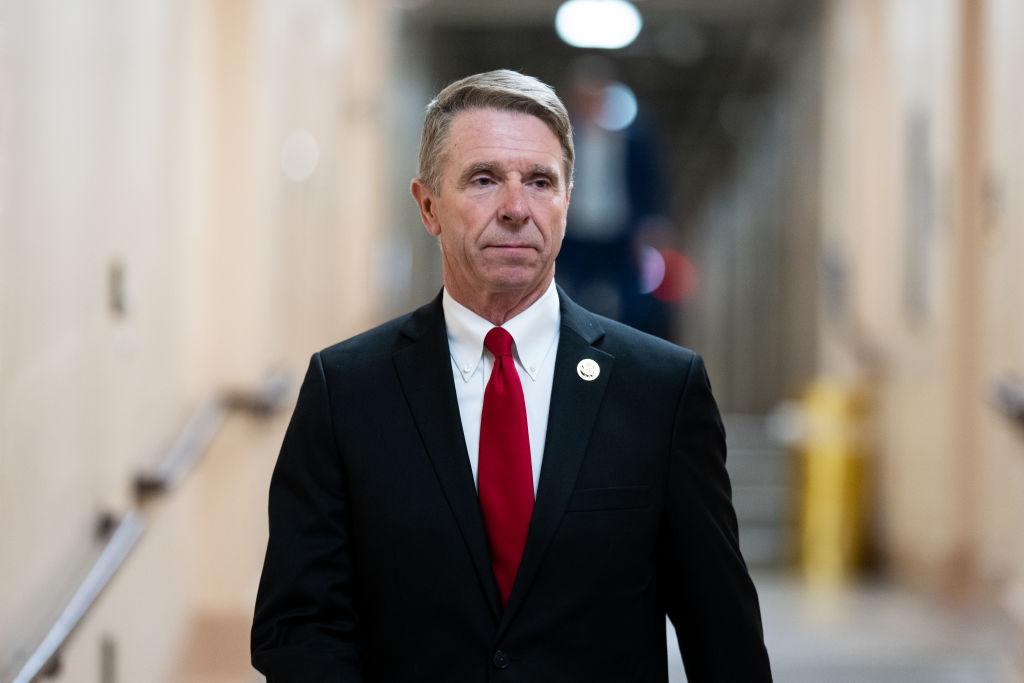
Some of the biggest GOP players in the Washington defense world are preparing to exit the stage next year, resulting in a major leadership shift that carries sweeping policy and spending implications.
Sen. Mitch McConnell (R-Ky.), chair of the Defense Appropriations Subcommittee, is retiring at the end of this Congress. House Armed Services Chair Mike Rogers (R-Ala.) is term-limited and will have to give up his gavel absent a waiver. And several other senior defense figures — like Reps. Ken Calvert (R-Calif.) and Rob Wittman (R-Va.) — face uphill reelection battles amid redistricting.
Let’s dig into the lawmakers who could emerge as the next class of congressional defense leaders.
House Armed Services. With Rogers preparing for the final year of his six-year term, people familiar with the committee’s dynamics say Wittman and Rep. Trent Kelly (R-Miss.) are the top contenders to lead the panel. GOP conference rules bar lawmakers from serving more than three consecutive terms at the helm of a committee, though members can seek waivers from leadership.
Wittman, who has served in Congress since 2007, is more senior and boasts deep ties to the defense sector. He currently serves as the vice chairman of the full committee and helms the Tactical Air and Land Forces Subcommittee. Wittman previously sought the top GOP committee slot in 2020, but Rogers beat him out for the job.
But Wittman faces a competitive reelection bid for his eastern Virginia seat — and that’s before the possible redistricting under consideration by commonwealth Democrats. A new map would likely make Wittman’s district even more difficult to win.
Kelly has represented northeast Mississippi since 2015 and serves as chair of the Seapower and Projection Forces Subcommittee. If Kelly were to win the gavel for the 120th Congress, his home state would wield even more leverage over defense spending and policy. Senate Armed Services Committee Chair Roger Wicker is also from Mississippi.
One factor shaping the candidate pool: the significant shakeup the House Armed Services roster has undergone in recent years. Several prominent Republicans have left or will leave:
— Rep. Mike Waltz (R-Fla.) left for the Trump administration.
— Rep. Mike Gallagher (R-Wis.) resigned from Congress.
— Rep. Jim Banks (R-Ind.) is now in the Senate.
— Rep. Elise Stefanik (R-N.Y.) is now running for governor of New York.
House Defense Appropriations. Calvert is unlikely to win another waiver to stay atop the defense spending panel. And that’s if Calvert survives reelection after California redistricting, known as Prop 50. He now faces a member-on-member battle against Rep. Young Kim (R-Calif.).
“The price of beef and Prop 50 will determine who the next chair is,” one House lawmaker said.
Calvert, who secured a waiver to continue serving as chair during the 119th Congress, has been on the Appropriations Committee since 2009. Calvert was first elected in 1992.
One possible successor is Rep. Steve Womack (R-Ark.), the second-most senior member of the Defense Appropriations Subcommittee. Womack currently chairs the Transportation, Housing and Urban Development Subcommittee.
Senate Defense Appropriations. With McConnell’s looming retirement, it’s not immediately clear who will step up to take his place.
Next up in seniority on the panel is Sen. Lisa Murkowski (R-Alaska), followed by Sen. Lindsey Graham (R-S.C.). McConnell took Sen. Susan Collins’ (R-Maine) leadership slot on the panel at the start of the 119th Congress when she became chair of the full committee. It’s possible Collins could seek to serve as chair of both the full panel and the subcommittee if she wins her competitive reelection.
– Briana Reilly and Anthony Adragna
PRESENTED BY THE BOEING COMPANY

Our integrated defense portfolio delivers advanced capabilities to meet the evolving security needs of the U.S. and its allies. With solutions that are connected, adaptable and ready, we are committed to supporting vital missions around the globe. Learn more
CONTRACTING CORNER
The business of defense faces big changes
President Donald Trump’s Washington is pushing to overhaul how the defense world supplies the U.S. military with war-fighting technologies. It’s a project that promises to impact how tens of billions of dollars are spent and shape what the next generation of war-fighting looks like.
It’s an all-of-government effort with White House executive orders, a push from Defense Secretary Pete Hegseth for changes at the Pentagon and Capitol Hill’s imprimatur through key provisions in its annual defense policy bill.
“This is as big a change for the Pentagon as Goldwater-Nichols,” said Rep. Rob Wittman (R-Va.), referencing the watershed 1986 law that restructured the Defense Department.
Déjà vu? The convergence of action is injecting new optimism into the long-running effort to make the Pentagon more nimble. The Trump administration is not the first to try to speed the process for purchasing equipment and grow the number of companies supplying the tools of war.
But Mike Brown, the former head of the Pentagon’s Defense Innovation Unit, said previous attempts have been more one-off in nature and not “as comprehensive as this.” Now, Brown said, the executive branch and Congress are “arm in arm” clamoring for change.
“It’s a reflection of how important commercial tech is,” Brown told us. “We need more than just F-35s and submarines.”
At the Pentagon, the changes include overhauling existing program executive offices and rolling out more flexible budget authorities. The compromise version of the NDAA, meanwhile, aims to codify many of those efforts.
The annual defense policy bill would also require DOD to prioritize buying commercial capabilities, exempt certain programs from some of the Pentagon’s most onerous regulations and bolster the acquisition workforce.
Moving out. The success of the endeavor ultimately depends on what happens next.
Aerospace Industries Association President and CEO Eric Fanning warned that a big hurdle is putting these measures into action, calling it “a lot of reform to implement at once.”
“The Pentagon is going to have to sort of rack and stack and prioritize what they do, because it will take sustained leadership effort to implement these changes,” Fanning said.
Any changes in this space will have big implications for the defense “primes” — Lockheed Martin, Boeing, Northrop Grumman, General Dynamics and RTX — and nontraditional companies looking to pitch commercial solutions to military problems, like Palantir and Anduril.
Already, there’s some concern the Defense Department could be softening its approach. Bill Greenwalt, a former Pentagon industrial policy chief who’s now a senior fellow at the American Enterprise Institute, argued in a recent op-ed that DOD’s final memo “watered down” earlier draft acquisition changes.
But at the Reagan National Defense Forum in Simi Valley, Calif., this weekend, Hegseth maintained his commitment to overhauling the acquisition process. Hegseth said the Pentagon would move “from the current prime contractor-dominated system” to one fueled “by dynamic vendor space” and defined by faster production.
“Our objective is simple, if monumental: transform the entire acquisition system to rapidly accelerate the building of capabilities and focus on results,” Hegseth said.
— Briana Reilly and Anthony Adragna
Editorial photos provided by Getty Images. Political ads courtesy of AdImpact.
Premium+ Defense is live
We’ve launched Defense! Our newest Premium+ coverage area takes you deeper into this rapidly evolving industry. From defense tech to appropriations, national security strategy, the military’s role domestically, aerospace and more, Punchbowl News Defense will be your go-to read.
Crucial Capitol Hill news AM, Midday, and PM—5 times a week
Join a community of some of the most powerful people in Washington and beyond. Exclusive newsmaker events, parties, in-person and virtual briefings and more.
Subscribe to PremiumThe Canvass Year-End Report

And what senior aides and downtown figures believe will happen in 2023.
Check it outEvery single issue of Punchbowl News published, all in one place
Visit the archive
Premium+ Defense is live
We’ve launched Defense! Our newest Premium+ coverage area takes you deeper into this rapidly evolving industry. From defense tech to appropriations, national security strategy, the military’s role domestically, aerospace and more, Punchbowl News Defense will be your go-to read.