


April 22, 2026



PRESENTED BY

THE TOP
What Democrats’ big Virginia win means
Happy Wednesday morning.
After their victory in Virginia on Tuesday night, the House majority is there for Democrats to take.
Democrats eliminated four GOP-held House seats in Virginia by convincing voters there to undo a redistricting commission put in place just six years ago. The Old Dominion’s House delegation next year will likely be 10 Democrats to just one Republican, a stunning turnabout for a state that was dominated by the GOP not that long ago.
The victory cost Democrats $65 million, and the final result was still a squeaker. Republicans are already pointing fingers at each other over whether they missed an opportunity to halt Democrats’ growing momentum and pull off an upset.
GOP troubles. We get it. It’s still early. There’s more than six months to go until Election Day. That’s forever in modern politics.
But there’s no sign at this point that President Donald Trump or House GOP leaders have the focus or messaging discipline to defend their razor-thin majority. Boosted by Trump’s presidential victory in 2024, Speaker Mike Johnson and House Republicans kept their majority intact — barely. Repeating that this year looks more difficult.
A couple of points to make:
— The implications of a Democratic House majority are enormous. It could mean a third impeachment for Trump, although Democrats claim that’s not on their agenda.
But it definitely would mean investigations and subpoenas for the White House and Cabinet officials, with all that entails legally and politically. There could also be even longer government shutdowns than the record-long “lapse in appropriations” that we’ve seen this Congress.
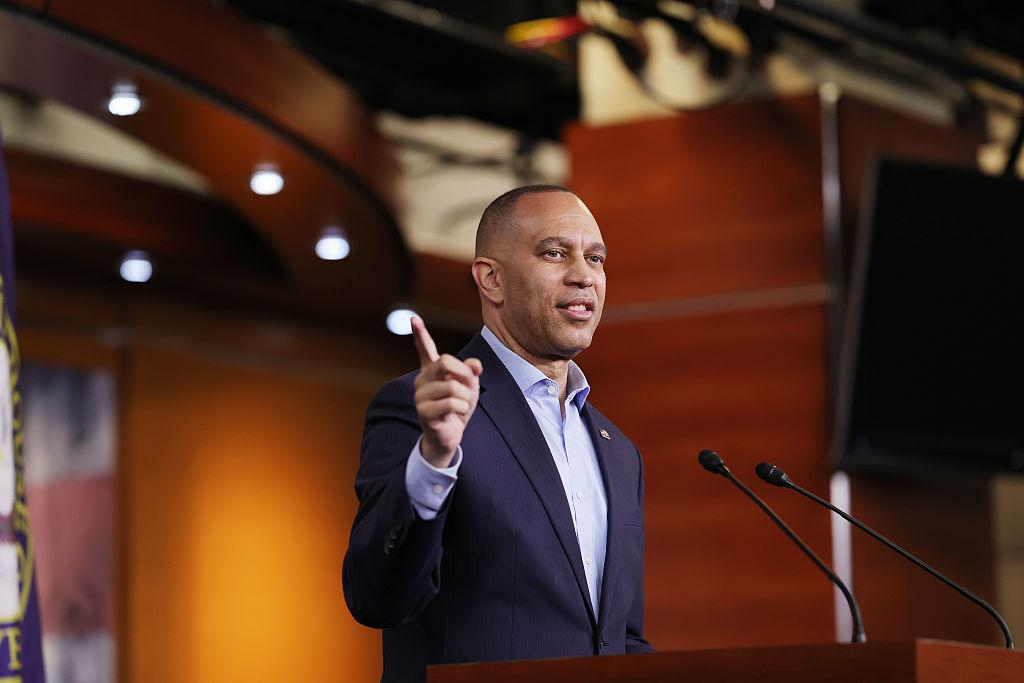
— It’s fair to say that, at this point, Republicans have lost the redistricting wars that they started last year in Texas at Trump’s urging. House Minority Leader Hakeem Jeffries is the winner.
“I told Mike Johnson in July of last year that, ‘If you go down this road, it’s not going to work out for you,’” Jeffries said in an interview Tuesday night.
More Jeffries on his warning to Johnson: “And at the end of the day, his best-case scenario was that he would net zero seats, but force at least 10 Republicans, who are incumbent members of his conference, into premature retirement. And that is exactly what has happened.”
The minority leader deserves lots of credit for Tuesday night’s win. Virginia Democrats had to pass an amendment twice through the state legislature, withstand a slew of legal challenges and then put it to the voters. A Jeffries-aligned nonprofit spent $38 million to make sure the measure passed.
Jeffries oversaw this effort from start to finish, setting up the referendum campaign, hiring staff and coordinating action on the ground. There was a lot of reluctance among Virginia Democrats over this gamble. That forced Jeffries to convince the delegation and the feuding chambers in the state legislature to get on board.
With his trademark caution, Jeffries declined to say whether Democrats won the majority last night or if a blue wave is looming. But he firmly declared Democrats won the redistricting fight.
“When you line up the congressional map in Texas and compare it with the response in California, they’re going to lose seats and would be fortunate if in Texas, they win two or three of the five seats that they claimed they were going to steal from Democrats,” Jeffries said.
The biggest wild cards left for both sides are Florida and the future of the Voting Rights Act, which is up to the Supreme Court.
Tuesday’s outcome puts a ton of pressure on Florida Gov. Ron DeSantis to push an aggressive congressional map next week that nets Republicans between three and five House seats.
Yet DeSantis faces skepticism from the Republican delegation and the GOP-controlled state legislature, which don’t believe they can go that big. Many Florida pols are warning that Latino voters aren’t reliably Republican and won’t turn out for the GOP like they did in 2024, so DeSantis should be cautious.
Knives out. There was a massive partisan spending gap in Virginia. On ads alone, Democrats spent $56.4 million. The GOP spent just $24.6 million.
The final result: Republicans lost by less than 90,000 votes out of more than 3 million cast.
Republicans will tell you they were trying to avoid nationalizing the race and igniting an angry Democratic base. More GOP spending would have only triggered more Democratic spending. Plus, the “No” campaign outperformed Trump’s 2024 results in Virginia.
Former Virginia Attorney General Jason Miyares and former House Majority Leader Eric Cantor, who led the anti-redistricting campaign, vowed to continue challenging the new map in courts.
But House Republicans were already sending us hair-on-fire messages Tuesday night. These Republicans say they were told that no amount of money could help the GOP in Virginia — but the close result suggests otherwise.
The American Action Network, a nonprofit aligned with Johnson, sent money to the nonprofit funding the “No” campaign, according to a person familiar with the transfer. But that dark money isn’t traceable and we don’t know how much they gave.
The Virginia GOP delegation will likely be decimated. GOP Rep. Rob Wittman (Va.) was drawn into Democratic Rep. Don Beyer’s new safe blue seat. GOP Reps. John McGuire and Jen Kiggans are now in light blue seats and in extreme danger.
There’s only one red seat left and it’s in the southwest. We hear Republican Reps. Ben Cline and Morgan Griffith could end up in a member-on-member race.
There are also a lot of questions about the NRCC, CLF and AAN’s decision-making. And you should expect that will continue — and even sharpen — in the coming days.
The new red seats nationally. Republicans drew five red seats in Texas. But let’s not forget that two of these seats were already red. Democratic Reps. Henry Cuellar and Vicente Gonzalez held Trump-won districts before the redraw. Both could still win despite the new map.
The other three new Texas seats are very likely to elect Republicans. Democrats are only planning to seriously contest one. Republicans are poised to pick up Rep. Emanuel Cleaver’s (D-Mo.) Kansas City-based seat. There are still some pending legal challenges, but things have been going well for the GOP there.
— Ally Mutnick, John Bresnahan and Jake Sherman
ICYMI: We held a conversation with Rep. Julie Fedorchak (R-N.D.) on American leadership in wireless and spectrum. She discussed the need for permitting reform and technology competition with China. Read all about it here. You can also watch the full video here.


THE SENATE
What to expect in the coming vote-a-rama
Senate Republicans are falling in line behind Majority Leader John Thune’s bid to keep the budget reconciliation bill narrowly focused on ICE and Border Patrol funding.
But Republicans who wanted to address cost-of-living concerns are planning to use the marathon vote-a-ramas — the first of which could begin as soon as tonight — to vent their frustration.
Some GOP senators have also taken to confronting the White House directly as they look for legislative wins. As we scooped Tuesday, Sen. John Kennedy (R-La.) went on a tirade against a top White House official during the closed-door Senate GOP lunch meeting. Kennedy said President Donald Trump needs to get more involved to push a long-stalled housing bill over the finish line.
For their part, Democrats want to use the vote-a-rama to exploit those GOP divisions and zero in on affordability.
“We’re going to focus almost exclusively on the cost of living,” Sen. Brian Schatz (D-Hawaii) told us. “Vote-a-ramas are known for being sprawling and unpredictable affairs.”
But because the budget resolution only instructs the Judiciary and Homeland Security committees, anything that falls outside those panels’ jurisdictions would require 60 votes. This could give vulnerable Senate Republicans cover to support some of the cost-of-living proposals, knowing that they won’t pass.
Still, Senate Democrats plan to push the issue. Senate Minority Leader Chuck Schumer will have an amendment aimed at blocking any bill “that does not lower out-of-pocket health care costs while Americans struggle to make ends meet.”
“Republicans are busy trying to fund a rogue police force, and Democrats are trying to lower your costs,” Schumer told us in an interview this week, summing up Democrats’ strategy.
On the GOP side. Republican amendments will target several different areas. Sen. Josh Hawley (R-Mo.) is expected to force a vote to extend the ban on Medicaid funding for Planned Parenthood, which expires July 4.
Kennedy said he’ll have amendments and has suggested at least one will be related to the SAVE America Act.
Sen. Ted Cruz (R-Texas) is still calling for a bigger reconciliation package, pressing for 10 years of ICE and Border Patrol funding and other priorities like indexing capital gains for inflation.
House tensions. Senate Republicans are hoping that by taking the initial steps on reconciliation, they can convince the House to take up the bipartisan DHS spending bill. The White House wants the House to pass it by the end of April. But it’s not clear how much reconciliation progress House Republicans will demand.
Sen. Ron Johnson (R-Wis.) has been pitching House GOP leaders on attaching his Shutdown Fairness Act to the DHS funding bill as a way to sweeten the deal. This legislation would ensure that federal employees continue to get paid in the event of a future shutdown.
— Andrew Desiderio and Laura Weiss
PRESENTED BY AMERICAN BEVERAGE

America’s beverage companies are making it easier than ever to find clear information about the ingredients in your favorite beverages. Learn more at GoodToKnowFacts.org.

Vault: Warsh off-ramp remains out of sight
The journey to get Kevin Warsh confirmed to chair the Federal Reserve has become a long and strange trip. Just about everyone piled into the car at this point — from Senate Majority Leader John Thune to Sen. Thom Tillis (R-N.C.) — would like to find an exit.
The problem is the driver: President Donald Trump. And Trump has repeatedly shown no interest in pulling off the highway.
Warsh’s hearing on Tuesday went as well as expected. Republicans loved him, and Democrats bludgeoned him. Warsh is a sure bet to sail through the Senate, likely on a party-line vote.
But the basic political obstacle remains the same. Tillis has now said dozens of times he won’t vote to advance Warsh through the Senate Banking Committee until the Justice Department drops its criminal inquiry into current Fed Chair Jay Powell. That’s a bottleneck that will keep Warsh from the floor.
“It’s their call,” Tillis told reporters after Tuesday’s hearing.
Swapsies? There’s been a lot of chatter about a trade that could placate both Tillis and Trump: having the Banking panel expand its longer-running probe into the Fed’s renovation costs.
CNBC Squawk Box’s Joe Kernen practically begged Trump to accept that as a potential off-ramp during an interview Tuesday. Trump declined. “I can’t imagine that ‘Too Late’ is taking money on construction. I can’t, but it’s possible,” Trump said of Powell. “But we have to find out.”
The challenge for Republicans and the Trump administration is that the Powell criminal matter most likely needs to be resolved before other options move forward — including a congressional probe or new internal investigation within the federal government.
Sources around the Banking panel say it’s unlikely the committee would expand its probe as long as a separate, criminal inquiry by DOJ is ongoing.
The Trump administration’s goal is to have Warsh in place when Powell’s term ends May 15, which means there’s pressure for a committee vote soon. The Senate is on recess the week of May 4.
Conversations are currently ongoing across the Trump administration and Congress about the path forward.
Banking Republicans remain upbeat. Mostly. “The president really would like to get a new man in and, really, there’s nothing standing in the way of this with the exception of an investigation,” Sen. Mike Rounds (R-S.D.) said. “With a little cooperation, I think we can get that done.”
– Brendan Pedersen and Laura Weiss

📆
What we’re watching
Senate. The Senate could begin the vote-a-rama that precedes final adoption of Republicans’ budget resolution as soon as tonight.
Senate Democrats will force a vote on an Iran war powers resolution from Sen. Tammy Baldwin (D-Wis.) that’s expected to fall short.
Health and Human Services Secretary Robert F. Kennedy Jr. will testify before the Senate Finance Committee and the Senate HELP Committee.
Commerce Secretary Howard Lutnick, Treasury Secretary Scott Bessent, Interior Secretary Doug Burgum, Agriculture Secretary Brooke Rollins and Energy Secretary Chris Wright will testify before their respective Appropriations subcommittees.
House. The Foreign Affairs Committee will markup more than 20 bills dealing with export controls, including the MATCH Act, at 10 a.m.
U.S. Trade Representative Jamieson Greer will testify before the House Ways and Means Committee at 10 a.m.
The House Appropriations Committee will continue its markup of the FY2027 Financial Services and General Government bill. House GOP appropriators will meet to strategize at 9 a.m. More than a dozen Democratic amendments are expected to be offered Wednesday.
Washington. The Supreme Court will issue opinions at 10 a.m.
President Donald Trump will meet with Internal Revenue Service CEO Frank Bisignano at 10 a.m.
Sens. Elizabeth Warren (D-Mass.) and Marsha Blackburn (R-Tenn.) will speak about the “looming AI crisis” at an event with the Vanderbilt Policy Accelerator at 12 p.m.
— Andrew Desiderio, Samantha Handler and Ben Brody
SPY AUTHORITY
House Dems work to coalesce around FISA
Republicans are still struggling to figure out a path forward to renew Section 702 of FISA, but Democrats are also laboring to get on the same page.
House Democratic leaders have given Rep. Jim Himes (D-Conn.), ranking member of the Intelligence Committee, and Rep. Jamie Raskin (D-Md.), ranking member of the Judiciary Committee, space to try to hammer out compromise reauthorization language.
Several Democrats predicted their colleagues would come along if Raskin signed off.
“We are very quickly trying to brainstorm our way through this,” Raskin said. “The Republicans would like to think that they can do this without us, but I don’t think that they can … I’m not sure that we can do it without them.”
Himes asserted there would be 290 votes for a package with some changes “if [Republicans] can just get their act together to do it” — noting the last reauthorization got support from 70% of the Democratic Caucus.
“Will those reforms satisfy everybody? Absolutely not,” Himes said.
Rep. Gregory Meeks (D-N.Y.), ranking member of the Foreign Affairs Committee, summed up the feeling of many Democrats: “If the two of them [Himes and Raskin] are in the same space, the rest of the caucus will be also.”
GOP perspective. House Intelligence Committee Chair Rep. Rick Crawford (R-Ark.) said a final FISA bill didn’t necessarily need to include a warrant requirement to clear the House.
“I think there’s a path forward that doesn’t go as far as a warrant requirement but that does provide a higher degree of accountability and transparency as it applies to the use of this tool,” Crawford said in an interview.
— Anthony Adragna and Briana Reilly
AND THERE’S MORE
Ad news: Sam Forstag, a Democrat running in Montana’s 1st District, is airing his first broadcast buy of the cycle. The $32,000 buy touts his endorsement from Sen. Bernie Sanders (I-Vt.) and slams “the rich and powerful.”
TikTok latest. Reps. Josh Gottheimer (D-N.J.), Tom Suozzi (D-N.Y.) and Elise Stefanik (R-N.Y.) are urging the American version of TikTok to require parents to verify their teens’ dates of birth when they create accounts.
The bipartisan trio also asked in a letter that the app use data that “TikTok already collects, to verify the age of users potentially under the age of 18.”
The lawmakers wrote that they’re worried about kids using the app, which officially bans users under age 13, as well as teens “bypassing TikTok’s built-in safeguards.”
Speaking of ages. Sens. Jerry Moran (R-Kan.) and Jacky Rosen (D-Nev.) introduced a Senate version of the Parents Over Platforms Act to give parents tools to adjust their kids’ phone experiences based on age.
It could set up House-Senate jockeying. Senate Commerce Committee Chair Ted Cruz (R-Texas) is considering bringing up Moran and Rosen’s priorities on kids and tech proposals. Both Moran and Rosen sit on the panel. But amid intense lobbying, the House went with a different approach, which focuses on verifying teens’ ages.
— Ben Brody and Max Cohen

Presented by Cencora

From accelerating innovation to powering the pharmaceutical supply chain, we reduce barriers to expand access to medications for millions of Americans at sites of care in their communities. Learn more

Crucial Capitol Hill news AM, Midday, and PM—5 times a week
Join a community of some of the most powerful people in Washington and beyond. Exclusive newsmaker events, parties, in-person and virtual briefings and more.
Subscribe to Premium
Special Projects
Explore our deep dives into the issues that matter the most today and will shape tomorrow's future, with expert reporting that goes beyond the headlines and into the heart of the Capitol.
Check it outEvery single issue of Punchbowl News published, all in one place
Visit the archive
Presented by Cencora
From accelerating innovation to powering the pharmaceutical supply chain, we reduce barriers to expand access to medications for millions of Americans at sites of care in their communities. Learn more