


June 1, 2026



PRESENTED BY
THE TOP
Trump’s slush-fund jam swamps Hill
Happy Monday morning. And welcome to June.
The Senate is in session today. The House doesn’t return until Wednesday. President Donald Trump is at the White House.
These are critical weeks for Trump and the GOP-controlled Congress, with just over five months left until Election Day. Trump has been bogged down in peace negotiations with Iran. The conflict remains at a stalemate somewhere between war and peace. Trump blames “Dumocrats, and various seemingly unpatriotic Republicans” for not understanding that “it will all work out well in the end.”
House Democrats will push war powers votes this week on both Iran and Lebanon, challenging vulnerable Republicans to once again line up behind Trump. There’s also a discharge petition vote on Ukraine aid to watch.
Plus, we’ll be watching key primaries in California, Iowa and other states this week.
Trump has been directly confronting Congress — especially his own party — on a number of fronts. From defeating GOP incumbents to trying to put his face on U.S. currency to attempting to drastically revise how elections are conducted, Trump continues to push the boundaries of executive power.
All of this has left trust between Trump and GOP senators, in particular, at a low point.
Now Trump and Republicans have a real problem on their hands, with two of the president’s priorities — immigration enforcement and rewarding his political allies — in conflict with each other, forcing GOP lawmakers along for the ride.
Weaponization of reconciliation. The Republican reconciliation bill to fund ICE and Border Patrol through the rest of Trump’s term is in real peril amid strident opposition to the administration’s $1.8 billion “anti-weaponization” fund.
First, let’s map out what Senate GOP leaders see as the ideal — let’s call it “ambitious” — timeline for this week. They want to begin the vote-a-rama on Wednesday night and pass the immigration reconciliation bill Thursday morning after an overnight marathon. Later Thursday, they want to hold a procedural vote on FISA Section 702, which expires June 12. More on that in a moment.
But the anti-weaponization fund is screwing up Trump’s ICE-and-CBP bill. As of now, Senate GOP leaders are struggling to see a clear path to 50 votes to kick off the floor process for the $70-plus billion reconciliation bill.
And Democrats want to make life even harder for GOP leaders.
There are two main avenues for addressing Republicans’ concerns about the fund — relying on the White House to impose guardrails or to scrap the fund entirely, versus addressing them within the bill itself.
Relying on the White House is tricky. Many Senate Republicans don’t trust the administration to honor its word, made worse by Trump’s toppling of GOP Sens. John Cornyn (Texas) and Bill Cassidy (La). All it takes to derail the process is four Republicans. Trump’s retribution campaign has effectively expanded the list of GOP senators willing to do this.
Alternatively, Republican leaders can try to find consensus language to restrict or kill the fund without losing more than three Republicans. Good luck with that.
Even if the initial 50-vote threshold is cleared — meaning there’s an agreement with the White House on addressing the weaponization fund — the drama won’t end.
Democrats will be able to use the vote-a-rama to offer amendments centered on the fund, some at a simple-majority threshold, even if the fund isn’t in the bill. Aides in both parties believe many of these will be considered at a simple-majority threshold regardless of whether the fund is actually mentioned in the underlying reconciliation bill. That decision is up to the parliamentarian.
“Senate Democrats will launch a coordinated effort to kill the slush fund before one cent goes out the door,” Senate Minority Leader Chuck Schumer said in a Dear Colleague letter out this morning. “And no matter what Republicans do, we will force them to vote on it.”
GOP leaders believe it’s nearly certain that enough Republicans will provide the votes for at least some of these to pass.
This would turn the vote-a-rama into a true Wild West, forcing Senate Majority Leader John Thune and Majority Whip John Barrasso to negotiate a “wrap-around” before final passage. That process would nullify successful amendments, a daunting task that often requires negotiating with individual senators.
Dem strategy. The anti-weaponization fund and its impact on the reconciliation bill have been a political gift to Democrats.
The twin controversies stemming from the reconciliation bill — the “anti-weaponization” fund and security funding for Trump’s White House ballroom — fit neatly into Democrats’ midterm messaging: Republicans don’t care about average Americans’ problems.
This morning, three Democratic senators who’ve been targeted by the Trump administration — Sens. Adam Schiff (Calif.), Mark Kelly (Ariz.) and Elissa Slotkin (Mich.) — are introducing legislation barring the creation of these funds if they stem from a lawsuit by the president or vice president.
FISA update. Negotiators are close to a bipartisan deal that would reauthorize FISA Section 702 for three years, according to multiple sources involved in the talks.
This is a Senate-driven process, with Intelligence Committee Vice Chair Mark Warner (D-Va.) seeking to maximize Democratic support. There’s been close coordination with the House and the White House.
Aides in both parties expect the final product to pass with support from a majority of Senate Republicans and a minority of Democratic senators.
This is news: The negotiated bill is expected to include a key sweetener to attract votes from privacy hawks who have long called for reforms to Section 702: a provision that narrows the definition of an electronic communications service provider. An ECSP is the type of company that would be required to provide records to the government.
— John Bresnahan, Andrew Desiderio, Jake Sherman and Laura Weiss


THE SENATE MAP
Turek surges as Wahls bemoans spending gap
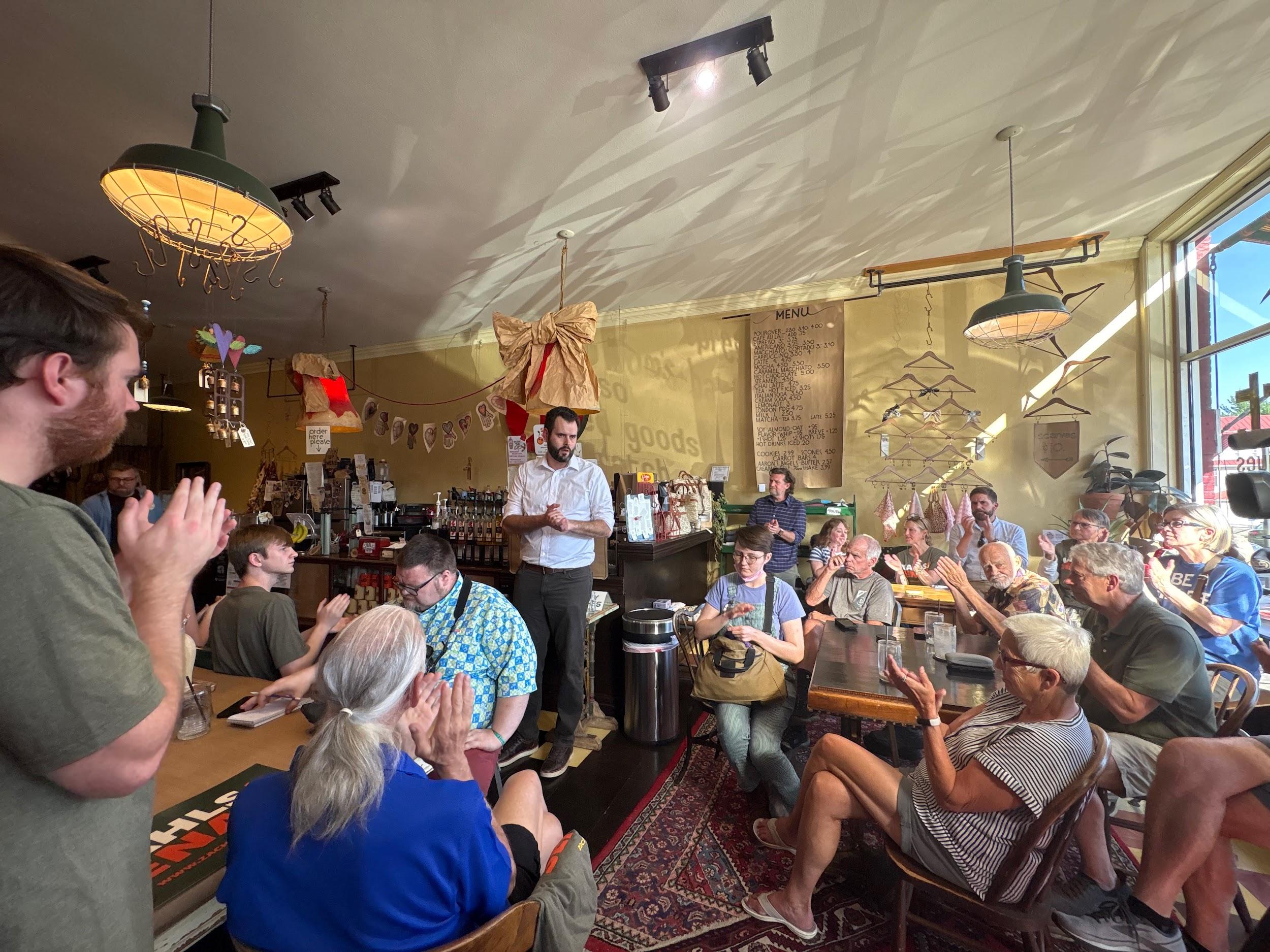
MOUNT VERNON, Iowa — State Sen. Zach Wahls is spending the closing stretch of the Iowa Senate Democratic primary railing against the $10 million-plus spent by VoteVets to boost his opponent, state Rep. Josh Turek, on the airwaves.
The avalanche of TV ad spending, which Wahls labeled “unprecedented,” has catapulted Turek into the driver’s seat in the June 2 primary. Turek argues his history of winning a GOP-leaning state house seat means he’s best positioned to defeat Rep. Ashley Hinson (R-Iowa) in the fall.
Wahls, an anti-establishment progressive who has vowed to oppose Senate Minority Leader Chuck Schumer, sees it differently.
“If you think it is going to be easier to beat Ashley Hinson with a candidate who needed $10 million of outside help just to win the nomination, I got a bridge to sell you,” Wahls told supporters last week.
Iowa Democrats we spoke with during a swing through the state expressed disappointment that the primary had become so fractious. For the first time in multiple cycles, Democrats believe they have a real shot at winning the state’s Senate seat.
At a Sioux City, Iowa, event on Thursday, Turek didn’t mention Wahls at all during his stump speech.
“I’m not a big fan of the Democrat-on-Democrat crime, and I think far too often we eat our own,” Turek told us after. “We got to beat Ashley Hinson. This was never about me versus Wahls. This is about a once-in-a-generation opportunity to be able to win [Democratic] Sen. [Tom] Harkin’s seat back.”
Both parties are gearing up for an expensive battle in November. SLF, the GOP super PAC, has reserved $29 million in ads, while SMP — the Democratic counterpart — has reserved $13 million.
Hinson is touting President Donald Trump’s endorsement and told us she views Turek and Wahls as equally flawed.
“I will beat whichever of them comes out of the primary,” Hinson said. “They both support raising taxes on working families, they have continued to prioritize illegal immigrants over Americans and they both support allowing gender transition surgeries on minors.”
Hinson said the GOP’s tax-cut package from last year is a major asset on the campaign trail, citing statistics that show Iowans “get to keep more of their own money” than residents of any other state.
Turek and Wahls are framing their entire campaigns railing against the One Big Beautiful Bill’s massive Medicaid cuts.
“Ashley Hinson is spending too much time in D.C. with her millionaire friends,” Turek said. “If she went to these rural communities and talked to these health care facilities, they would absolutely tell you that the lifeblood for these health care facilities is Medicaid.”
Even though Trump won Iowa by 13 points in 2024, Wahls said Hinson’s embrace of Trump is a liability in this election.
“If you gave Ashley Hinson a truth serum, she would probably tell you that it’s not popular to campaign with Donald Trump in a state like Iowa right now. But she can’t, because Donald Trump owns the Republican Party,” Wahls said.
— Max Cohen
PRESENTED BY PCMA

Pharmacy benefit managers reduce prescription drug spending by $300 billion each year by negotiating lower drug prices and finding savings for people like you.
ROADS AND BRIDGES
The highway bill’s next hurdles
The House’s highway bill is already hitting major roadblocks.
For one, it’s unclear if the bill can pass the House. Many Democrats don’t like the proposed $130 annual registration fee for EVs. The new fees for EVs and hybrids are also generating blowback from conservative circles beyond the Hill, who are framing them as new car taxes. Florida Republican Gov. Ron DeSantis is among the opponents. Plus, Hill conservatives are resistant to the bill’s $580 billion price tag.
Some Republicans don’t like the rail safety measure added during the markup. The measure was a White House priority. President Donald Trump’s legislative affairs team went as far as to whip committee members to support the amendment. House GOP leaders have said the provision makes it harder to pass the bill on the floor.
Still, 11 Republicans, including House Transportation and Infrastructure Committee Chair Sam Graves (R-Mo.), voted against the amendment.
Another House challenge. House Ways and Means Committee Republicans need to decide whether to hold a markup on sections of the bill that fall under their panel.
The problem for the Ways and Means panel is that holding a markup would involve dealing with the most politically fraught piece of the reauthorization: the gas tax. Hill Republicans have been cool to the idea of a gas tax holiday even as prices soar, but it’s harder to ignore Trump’s desire for a suspension when taking up the tax itself. Voting for a gas tax extension when the average price per gallon is $4.32 is difficult in itself.
A markup could also serve as a venue for House Democrats to push back on EV fees and seek a gas tax holiday through amendments, putting the GOP in an uncomfortable spot and turning it into a partisan ordeal.
Ways and Means Republicans have started discussing options with committee members. That will likely continue when the House returns this week.
The Senate. Negotiators on the Senate Environment and Public Works Committee have said talks are going well, but they need input from other chairs and Senate leadership.
Sen. Sheldon Whitehouse (R.I.), the panel’s top Democrat, said before recess that he and the committee’s chair, Shelley Moore Capito (R-W.Va.), need the other committees with jurisdiction to engage. Whitehouse said they’re also waiting to hear from Senate GOP leadership on the topline so they can proceed.
The Senate Commerce, Banking and Finance Committees also each have a piece of the package. There’s not much time left to coordinate.
The permitting reform curveball. The White House is closely monitoring the permitting reform talks in the Senate. If those talks wrap up, the administration would be open to including the product in the highway bill.
Congress has until Sept. 30 to renew the highway and transit programs that fund much of the nation’s roads, bridges and public transportation systems.
— Samantha Handler, Laura Weiss and Jake Sherman
PRESENTED BY PCMA

PBMs save the average American more than $1,000 each year.
📆
What we’re watching this week
Monday. Democratic Sens. Adam Schiff (Calif.), Mark Kelly (Ariz.) and Elissa Slotkin (Mich.) will hold a 6 p.m. news conference on their proposal to ban the creation of settlement funds arising from a lawsuit filed by the president or vice president.
Tuesday. Secretary of State Marco Rubio will testify at the Senate Foreign Relations Committee and the House Appropriations Committee.
Homeland Security Secretary Markwayne Mullin will testify before the Senate Appropriations Committee.
Tuesday is primary day in California, Iowa, New Jersey, South Dakota, Montana and New Mexico.
Acting Attorney General Todd Blanche will testify at the House Appropriations Committee.
Wednesday. Rubio will testify at the House Foreign Affairs Committee and Senate Appropriations panel.
Treasury Secretary Scott Bessent will testify at the Senate Finance Committee.
Mullin will be at the House Homeland Security Committee.
— Jake Sherman and Andrew Desiderio

K St: Third reconciliation bill is unlikely
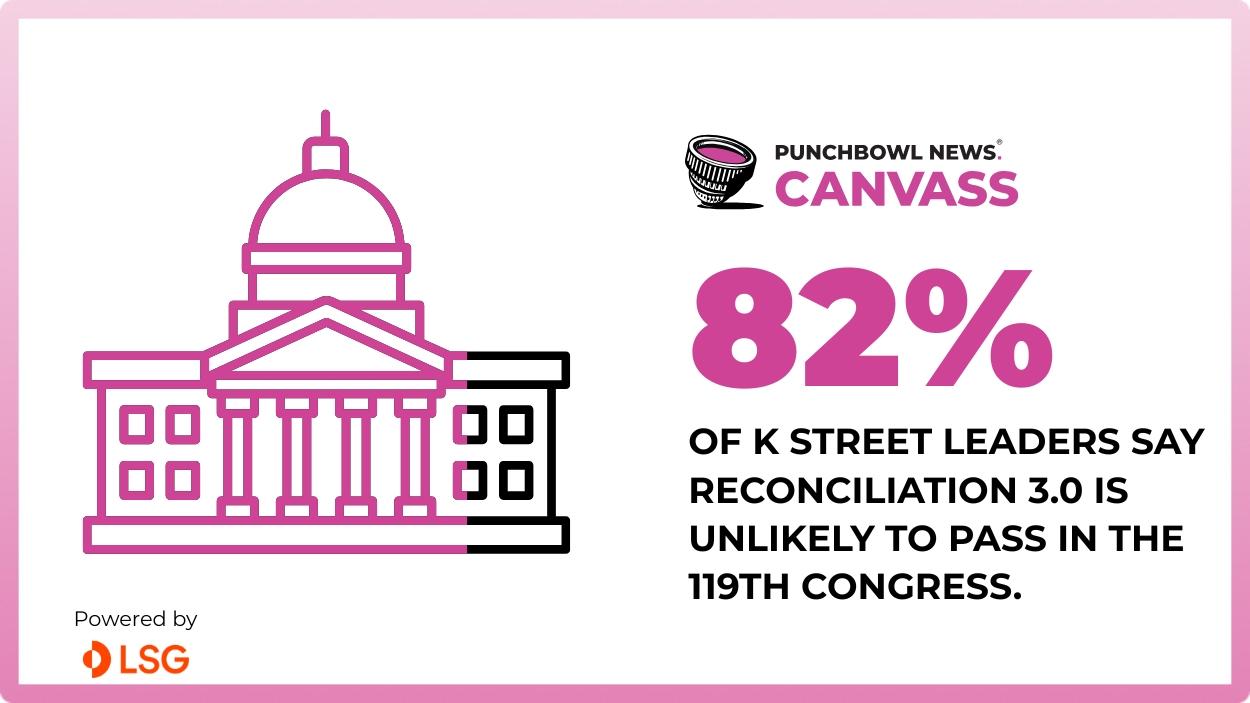
A majority of K Street leaders say a third reconciliation bill is unlikely to pass the 119th Congress, according to our latest Canvass survey.
Despite the pessimism, most respondents say supplemental military funding for the war in Iran (79%) and taxes (51%) would be addressed in such a package.
Where it stands. A third reconciliation bill could include hundreds of billions of dollars in defense funding. House Budget Committee Chair Jodey Arrington (R-Texas) said he wants to pass the reconciliation package before the August recess.
Arrington also said he wants to cut “fraud” and include provisions to make housing and health care more affordable.
K Street respondents are more optimistic about a second reconciliation bill, with 88% of respondents saying a package would pass.
Senate Republicans were set to pass the roughly $70 billion package to fund ICE and CBP before recess, but President Donald Trump’s $1.8 billion “anti-weaponization” fund drew GOP blowback and derailed the bill.
The Canvass K Street was conducted May 4-22 in partnership with independent public affairs firm, LSG.
Want to take part in The Canvass? Our survey provides anonymous monthly insights from top Capitol Hill staffers and K Street leaders on key issues facing Washington.
Don’t miss out on your chance to weigh in! Sign up here if you work on K Street. Click here to sign up if you’re a senior congressional staffer.
– Shania Shelton
AND THERE’S MORE
Ad news: New Democrat Majority, the independent expenditure arm of the New Dems’ campaign wing, is launching a $1 million ad buy boosting former Rep. Ben McAdams (D-Utah) in Utah’s 1st District. The ad hails McAdams as a fighter who voted to impeach President Donald Trump.
Endorsement news: Former Transportation Secretary Pete Buttigieg is endorsing Democrat Jonathan Nez in his campaign to unseat Rep. Eli Crane (R-Ariz.).
Tax. The GAO will conduct a review of options for free tax filing at the request of Sens. Elizabeth Warren (D-Mass.), Ron Wyden (D-Ore.) and Angus King (I-Maine).
The GAO said in a letter that it will look into the issue after the senators raised concerns about the existing Free File system. In their May request to the GAO, the members asked the agency to examine what they called “a history of misconduct” by Free File’s private-sector partners.
— Max Cohen and Catherine Leffert

Presented by Cencora

From accelerating innovation to powering the pharmaceutical supply chain, we reduce barriers to expand access to medications for millions of Americans at sites of care in their communities. Learn more

Crucial Capitol Hill news AM, Midday, and PM—5 times a week
Join a community of some of the most powerful people in Washington and beyond. Exclusive newsmaker events, parties, in-person and virtual briefings and more.
Subscribe to Premium
Special Projects
Explore our deep dives into the issues that matter the most today and will shape tomorrow's future, with expert reporting that goes beyond the headlines and into the heart of the Capitol.
Check it outEvery single issue of Punchbowl News published, all in one place
Visit the archive
Presented by Cencora
From accelerating innovation to powering the pharmaceutical supply chain, we reduce barriers to expand access to medications for millions of Americans at sites of care in their communities. Learn more